Learning Spanish can become confusing when one verb has several forms for different subjects. The verb ser, meaning “to be,” is one of the most important Spanish verbs, and its past tense conjugation is especially important for beginners.
You may already know forms such as soy and eres, but what happens when you want to say “I was,” “she was,” or “they were”?
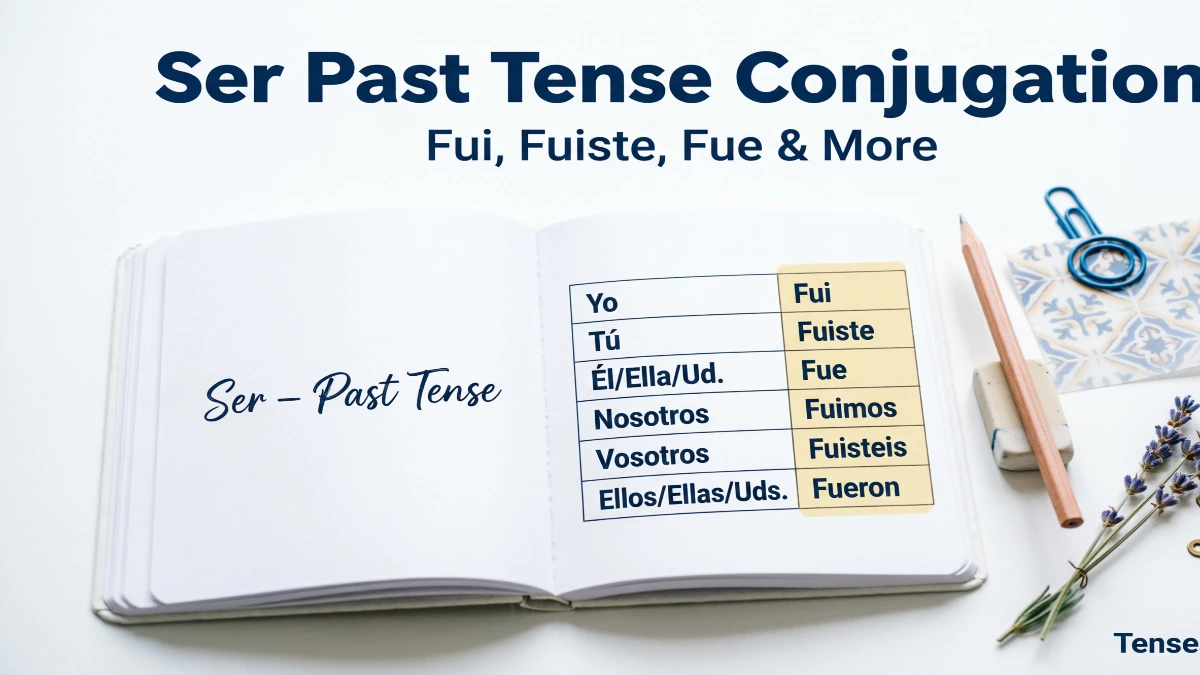
In Spanish, ser has different past tense forms depending on the subject. In the preterite, the forms are fui, fuiste, fue, fuimos, fuisteis, and fueron. These forms are irregular, so they cannot be created by simply adding a normal verb ending.
The past tense of ser is used to talk about identity, characteristics, occupations, events, relationships, and other situations viewed as completed or bounded in the past.
This guide explains ser past tense conjugation, when to use it, how it differs from estar, common mistakes, and practical examples.
Quick Answer
The most common completed past tense conjugation of ser is its preterite form:
| Subject | Ser – Preterite |
|---|---|
| Yo | fui |
| Tú | fuiste |
| Él/Ella/Usted | fue |
| Nosotros/as | fuimos |
| Vosotros/as | fuisteis |
| Ellos/Ellas/Ustedes | fueron |
Example: Yo fui estudiante. = “I was a student.”
The verb ser is irregular in the preterite, so these forms must be learned and practiced.
What Is Ser Past Tense Conjugation?
Ser past tense conjugation means changing the Spanish verb ser to show that a state, identity, characteristic, or other situation existed in the past.
The verb ser means “to be.” It is one of the two main Spanish verbs translated as “to be.” The other is estar.
For example:
- Soy estudiante. = I am a student.
- Fui estudiante. = I was a student.
- Ella fue profesora. = She was a teacher.
- Ellos fueron amigos. = They were friends.
The preterite forms of ser are:
fui, fuiste, fue, fuimos, fuisteis, fueron
These forms are irregular because they do not look like the base verb ser.
What Does Ser Describe in the Past?
The verb ser can describe several types of information:
- Identity
- Occupation
- Nationality or origin
- Characteristics
- Relationships
- Time or dates
- Events
- Ownership or association
- A completed situation viewed as a whole
Examples:
- Fui estudiante. I was a student.
- Ella fue muy amable. She was very kind.
- La reunión fue el lunes. The meeting was on Monday.
- Fuimos buenos amigos. We were good friends.
Structure of Sentences of Ser Past Tense Conjugation
The basic sentence order with the preterite of ser is straightforward.
Affirmative Sentences
Pattern:
Subject + ser in the preterite + complement
Examples:
- Yo fui estudiante. I was a student.
- Tú fuiste amable. You were kind.
- Ella fue profesora. She was a teacher.
- Nosotros fuimos amigos. We were friends.
- Ellos fueron campeones. They were champions.
Spanish often leaves out the subject pronoun because the verb form already shows who the subject is.
For example:
- Fui estudiante. = I was a student.
- Fuimos amigos. = We were friends.
Negative Sentences
Pattern:
Subject + no + ser in the preterite + complement
Examples:
- No fui estudiante. I was not a student.
- No fuiste amable. You were not kind.
- Ella no fue profesora. She was not a teacher.
- No fuimos amigos. We were not friends.
- Ellos no fueron campeones. They were not champions.
The word no normally comes directly before the conjugated verb.
Interrogative Sentences
Pattern:
¿Ser in the preterite + subject + complement?
Examples:
- ¿Fuiste estudiante? Were you a student?
- ¿Fue ella profesora? Was she a teacher?
- ¿Fueron ellos campeones? Were they champions?
- ¿Fuimos buenos amigos? Were we good friends?
Spanish does not need an auxiliary equivalent to English did to form these questions.
Formation of Ser Past Tense Conjugation
The preterite of ser is highly irregular. Instead of taking the normal endings expected from the infinitive ser, it uses a special set of forms.
The Six Preterite Forms
| Person | Conjugation |
|---|---|
| Yo | fui |
| Tú | fuiste |
| Él/Ella/Usted | fue |
| Nosotros/Nosotras | fuimos |
| Vosotros/Vosotras | fuisteis |
| Ellos/Ellas/Ustedes | fueron |
These forms are used for the preterite, which commonly describes completed past situations or events.
There Is No Normal “Ser + Ending” Pattern
Beginners sometimes try to form the past tense by changing ser with regular endings. That does not work.
For example, these forms are incorrect:
- ❌ serí
- ❌ seriste
- ❌ serió
The correct forms are:
- ✅ fui
- ✅ fuiste
- ✅ fue
Because ser is irregular in the preterite, memorizing its six forms is important.
Helping Verbs
Spanish does not use an English style auxiliary did to create simple preterite questions and negatives.
For example:
- ¿Fuiste estudiante? Were you a student?
- No fui estudiante. I was not a student.
For perfect tenses, however, Spanish uses the auxiliary verb haber with the past participle of ser:
- He sido I have been
- Había sido I had been
The past participle of ser is sido.
Main Forms of Ser
| Form | Spanish |
|---|---|
| Infinitive | ser |
| Present participle | siendo |
| Past participle | sido |
| Preterite | fui, fuiste, fue, fuimos, fuisteis, fueron |
| Imperfect | era, eras, era, éramos, erais, eran |
| Conditional | sería, serías, sería, seríamos, seríais, serían |
Notice that fui is not the only past form of ser. Spanish also has the imperfect, such as era and éramos. Choosing between fui and era depends on the meaning and context.
How to Use Ser Past Tense Conjugation
The preterite forms of ser are used when the speaker presents the past situation as completed, bounded, or connected to a specific past event or period.
1. Talking About a Completed Identity or Role
Use ser in the preterite to describe what someone was in a completed past period or situation.
- Fui estudiante de esa universidad.
I was a student at that university. - Ella fue la directora del school.
She was the director of the school. - Él fue mi profesor.
He was my teacher.
2. Describing Past Characteristics
You can use fue, fueron, and other forms to describe characteristics viewed as completed or associated with a particular past event.
- El examen fue difícil.
The exam was difficult. - La película fue interesante.
The movie was interesting. - Las vacaciones fueron increíbles.
The vacation was amazing.
3. Talking About Events
One important use of ser in the preterite is describing when or where an event took place.
- La reunión fue el lunes.
The meeting was on Monday. - El concierto fue en Madrid.
The concert was in Madrid. - La fiesta fue en mi casa.
The party was at my house.
This is an important pattern for Spanish learners:
El evento fue + time/place.
4. Talking About Relationships
Use ser to describe relationships that existed during a completed period.
- Fuimos buenos amigos.
We were good friends. - Ellos fueron compañeros de trabajo.
They were coworkers. - Ella fue mi mejor amiga.
She was my best friend.
5. Talking About Nationality or Origin in a Past Context
Depending on context, ser can describe where someone was from or their nationality.
- Fue mexicano.
He was Mexican. - Fueron españoles.
They were Spanish.
The exact tense choice depends on if the speaker is describing a completed past period or a continuing background fact.
6. Describing a Completed Event
Use fue or fueron when describing an event as a whole.
- El viaje fue excelente.
The trip was excellent. - La conferencia fue muy útil.
The conference was very useful. - Las vacaciones fueron cortas.
The vacation was short.
Structure or Verb Pattern Table
| Subject | Ser Preterite | English |
|---|---|---|
| Yo | fui | I was |
| Tú | fuiste | You were |
| Él/Ella/Usted | fue | He/She/You were |
| Nosotros/as | fuimos | We were |
| Vosotros/as | fuisteis | You were |
| Ellos/Ellas/Ustedes | fueron | They/You were |
Note: The forms fui, fuiste, fue, fuimos, fuisteis, fueron are also the preterite forms of ir (“to go”). Context tells you if the verb means ser or ir.
Real Life Examples
Affirmative Examples
- Fui estudiante de esta escuela.
I was a student at this school. - Fuiste muy amable conmigo.
You were very kind to me. - Ella fue mi profesora.
She was my teacher. - Fuimos buenos amigos.
We were good friends. - Fuisteis muy pacientes.
You were very patient. - Ellos fueron los ganadores.
They were the winners.
Negative Examples
- No fui estudiante de esa escuela.
I was not a student at that school. - No fuiste responsable del problema.
You were not responsible for the problem. - Ella no fue la directora.
She was not the director. - No fuimos compañeros de clase.
We were not classmates. - Ellos no fueron los ganadores.
They were not the winners.
Interrogative Examples
- ¿Fuiste estudiante aquí?
Were you a student here? - ¿Fue ella tu profesora?
Was she your teacher? - ¿Fuimos buenos amigos?
Were we good friends? - ¿Fueron ellos los ganadores?
Were they the winners?
Formal Examples
- La conferencia fue muy importante para la comunidad.
The conference was very important for the community. - El evento fue organizado el viernes.
The event was organized on Friday. - La reunión fue en la oficina principal.
The meeting was at the main office.
Informal Examples
- La película fue genial.
The movie was great. - Fuiste muy divertido ayer.
You were very funny yesterday. - Fuimos mejores amigos en la escuela.
We were best friends at school.
Examples With Events
- El partido fue el sábado.
The match was on Saturday. - La boda fue en junio.
The wedding was in June. - La reunión fue en casa de Ana.
The meeting was at Ana’s house.
Common Mistakes
Mistake 1: Trying to Form the Preterite Regularly
Incorrect:
❌ Yo serí estudiante.
Correct:
✅ Yo fui estudiante.
Explanation: Ser is irregular in the preterite. Use fui for yo.
Mistake 2: Using “Fue” With Every Subject
Incorrect:
❌ Nosotros fue estudiantes.
Correct:
✅ Nosotros fuimos estudiantes.
Explanation: The verb must agree with the subject.
- Yo → fui
- Tú → fuiste
- Él/Ella/Usted → fue
- Nosotros/as → fuimos
- Vosotros/as → fuisteis
- Ellos/Ellas/Ustedes → fueron
Mistake 3: Adding “Did” to a Spanish Question
Incorrect:
❌ ¿Did fuiste estudiante?
Correct:
✅ ¿Fuiste estudiante?
Explanation: Spanish does not use English did to form a basic preterite question.
Mistake 4: Confusing Ser and Estar
Incorrect in a context requiring ser:
❌ La reunión estuvo el lunes.
Correct:
✅ La reunión fue el lunes.
Explanation: Spanish commonly uses ser to state when or where an event took place.
Mistake 5: Confusing Fui With Era
Both fui and era can translate as “I was,” but they are not interchangeable in every situation.
- Fui estudiante durante cuatro años.
I was a student for four years. - Era estudiante cuando lo conocí.
I was a student when I met him.
The first presents the period as completed. The second provides background information for another past event.
Mistake 6: Forgetting That Fui Can Also Mean “I Went”
The form fui can mean either:
- I was from ser
- I went from ir
Examples:
- Fui estudiante. → I was a student.
- Fui al mercado. → I went to the market.
Context determines the meaning.
Key Grammar Rules
- The preterite of ser is irregular.
Learn the six forms: fui, fuiste, fue, fuimos, fuisteis, fueron. - Use the form that agrees with the subject.
- Yo fui
- Nosotros fuimos
- Ellos fueron
- Do not use “did” to form basic Spanish preterite questions.
- ✅ ¿Fuiste estudiante?
- ❌ ¿Did fuiste estudiante?
- Use no before the conjugated verb for a negative sentence.
- No fui estudiante.
- Ser can describe identity, occupation, characteristics, relationships, and events.
- Ser is commonly used for the time and location of events.
- La reunión fue el lunes.
- Fui and fue can come from either ser or ir.
- Fui profesor. = I was a teacher.
- Fui al banco. = I went to the bank.
Comparisons with Similar Grammar Forms
Ser Preterite vs. Ser Imperfect
This is one of the most important distinctions for learners.
| Preterite | Imperfect |
|---|---|
| fui | era |
| fuiste | eras |
| fue | era |
| fuimos | éramos |
| fuisteis | erais |
| fueron | eran |
The preterite often presents a past situation as completed or bounded.
La película fue interesante.
The movie was interesting.
The imperfect often gives background information or describes an ongoing/repeated past state.
La película era interesante.
The movie was interesting.
The exact choice depends on context, not simply on if the English sentence contains “was” or “were.”
Ser vs. Estar in the Past
Spanish uses both ser and estar, even though both can translate as “to be.”
Compare:
- La fiesta fue en Madrid.
The party was in Madrid. - Ana estuvo en Madrid.
Ana was in Madrid.
A useful beginner rule is that ser is commonly used for identity, characteristics, and events, while estar is commonly used for location and temporary states.
Fui vs. Era
Both can translate as “I was.”
Use fui when presenting the situation as completed:
Fui profesor durante diez años.
I was a teacher for ten years.
Use era when the situation is background information:
Era profesor cuando conocí a Ana.
I was a teacher when I met Ana.
Fue vs. Estuvo
Both may translate as “was,” but they have different uses.
- La conferencia fue interesante.
The conference was interesting. - El profesor estuvo en la conferencia.
The teacher was at the conference.
The first describes the event. The second describes a person’s location or presence.
Ser Preterite vs. Haber
The verb haber can also appear in past expressions, but it does not simply replace ser.
- Fue una reunión importante.
It was an important meeting. - Hubo una reunión importante.
There was an important meeting.
Fue identifies or describes the event, while hubo introduces the existence or occurrence of an event.
Exercises
Exercise 1: Fill in the Blanks
Complete each sentence with the correct preterite form of ser.
- Yo ______ estudiante.
- Tú ______ muy amable.
- Ella ______ mi profesora.
- Nosotros ______ buenos amigos.
- Vosotros ______ muy pacientes.
- Ellos ______ los ganadores.
- La reunión ______ el lunes.
- Mis padres ______ profesores.
Exercise 2: Choose the Correct Answer
- What is the preterite form of ser for yo?
a) era
b) fui
c) fue - What is the correct form for nosotros?
a) fuimos
b) fueron
c) fuisteis - Which sentence means “She was a teacher”?
a) Ella era profesora.
b) Ella fue profesora.
c) Both can be correct depending on context. - Which sentence is grammatically correct?
a) ¿Did fuiste estudiante?
b) ¿Fuiste estudiante?
c) ¿Fuiste did estudiante? - Which form means “they were”?
a) fuimos
b) fueron
c) fuisteis
Exercise 3: Correct the Mistakes
Rewrite each sentence correctly.
- Yo fue estudiante.
- Nosotros fueron amigos.
- ¿Did fuiste profesor?
- Ellos fue los ganadores.
- Yo serí estudiante.
Exercise 4: Translate Into Spanish
- I was a student.
- You were very kind.
- She was my teacher.
- We were good friends.
- They were the winners.
- The meeting was on Monday.
Exercise 5: Ser or Ir?
Decide if the bold verb means “was/were” from ser or “went” from ir.
- Fui estudiante.
- Fui al supermercado.
- Fueron profesores.
- Fueron a España.
- Fuimos buenos amigos.
- Fuimos al concierto.
Answer Key
Exercise 1
- fui
- fuiste
- fue
- fuimos
- fuisteis
- fueron
- fue
- fueron
Exercise 2
- b) fui
- a) fuimos
- c) Both can be correct depending on context.
- b) ¿Fuiste estudiante?
- b) fueron
Exercise 3
- Yo fui estudiante.
- Nosotros fuimos amigos.
- ¿Fuiste profesor?
- Ellos fueron los ganadores.
- Yo fui estudiante.
Exercise 4
- Fui estudiante.
- Fuiste muy amable.
- Ella fue mi profesora.
- Fuimos buenos amigos.
- Ellos fueron los ganadores.
- La reunión fue el lunes.
Exercise 5
- Ser was
- Ir went
- Ser were
- Ir went
- Ser were
- Ir went
Frequently Asked Questions (FAQs)
What is the past tense of ser in Spanish?
The most common completed past tense, the preterite, is:
fui, fuiste, fue, fuimos, fuisteis, fueron.
What does fui mean?
Fui can mean “I was” from ser or “I went” from ir.
- Fui estudiante. = I was a student.
- Fui al banco. = I went to the bank.
What is the past tense of ser for tú?
The preterite form for tú is fuiste.
Fuiste muy amable.
You were very kind.
What is the past tense of ser for él and ella?
The form is fue.
- Él fue profesor. = He was a teacher.
- Ella fue estudiante. = She was a student.
What is the past tense of ser for nosotros?
The form is fuimos.
Fuimos buenos amigos.
We were good friends.
What is the past tense of ser for ellos?
The form is fueron.
Ellos fueron estudiantes.
They were students.
Is ser irregular in the preterite?
Yes. Ser is highly irregular in the preterite. Its forms are fui, fuiste, fue, fuimos, fuisteis, fueron.
Is “fue” ser or estar?
Fue is the preterite form of ser, not estar. The preterite form of estar is estuvo for él/ella/usted.
What is the difference between fui and era?
Both can mean “I was,” but fui is the preterite and commonly presents a past situation as completed, while era is the imperfect and often gives background or describes an ongoing past state.
What is the difference between ser and estar in the past?
Both mean “to be,” but they serve different grammatical purposes. Ser is commonly used for identity, characteristics, and events, while estar is commonly used for location and temporary states.
What is the past participle of ser?
The past participle of ser is sido.
Example:
He sido estudiante.
I have been a student.
What is the imperfect form of ser?
The imperfect forms are:
era, eras, era, éramos, erais, eran.
These are different from the preterite forms fui, fuiste, fue, fuimos, fuisteis, fueron.
Conclusion
Learning ser past tense conjugation is essential for speaking and writing Spanish accurately. In the preterite, ser has six irregular forms: fui, fuiste, fue, fuimos, fuisteis, and fueron. These forms can describe completed past identities, characteristics, relationships, occupations, and events.
One important point to remember is that fui, fuiste, fue, fuimos, fuisteis, and fueron are also forms of ir, meaning “to go.” Context tells you if the sentence means “was/were” or “went.” You should also learn the difference between fui and era, because both can translate as “was” but are used differently.
Practice the six forms with short sentences, especially common patterns such as fui estudiante, fue mi profesor, and fueron los ganadores. With regular practice, Spanish past tense ser will become much easier to recognize and use naturally.