Have you ever tried to translate the English word “was” into Spanish and felt confused? Many English learners expect a single Spanish word that always means “was.” However, Spanish works differently. Depending on the situation, “was” in Spanish past tense can be translated as era, fue, estaba, or estuvo.
This often creates confusion because Spanish has two main past tenses that describe the past in different ways. For example, “She was happy” and “She was at the store” may use different Spanish verbs and forms.
Understanding how Spanish expresses “was” is important for speaking, writing, reading, and everyday conversations. Once you learn the difference between these forms, your Spanish sentences will sound much more natural and accurate.
In this guide, you’ll learn what “was” means in Spanish, how to form it, when to use each form, common mistakes, examples, exercises, and practical grammar tips.
Quick Answer (Featured Snippet)
The English word “was” does not have just one Spanish translation. It changes based on meaning and situation.
| English | Spanish |
|---|---|
| I was | yo era / yo fui / yo estaba / yo estuve |
| He was | él era / él fue / él estaba / él estuvo |
| She was | ella era / ella fue / ella estaba / ella estuvo |
Generally:
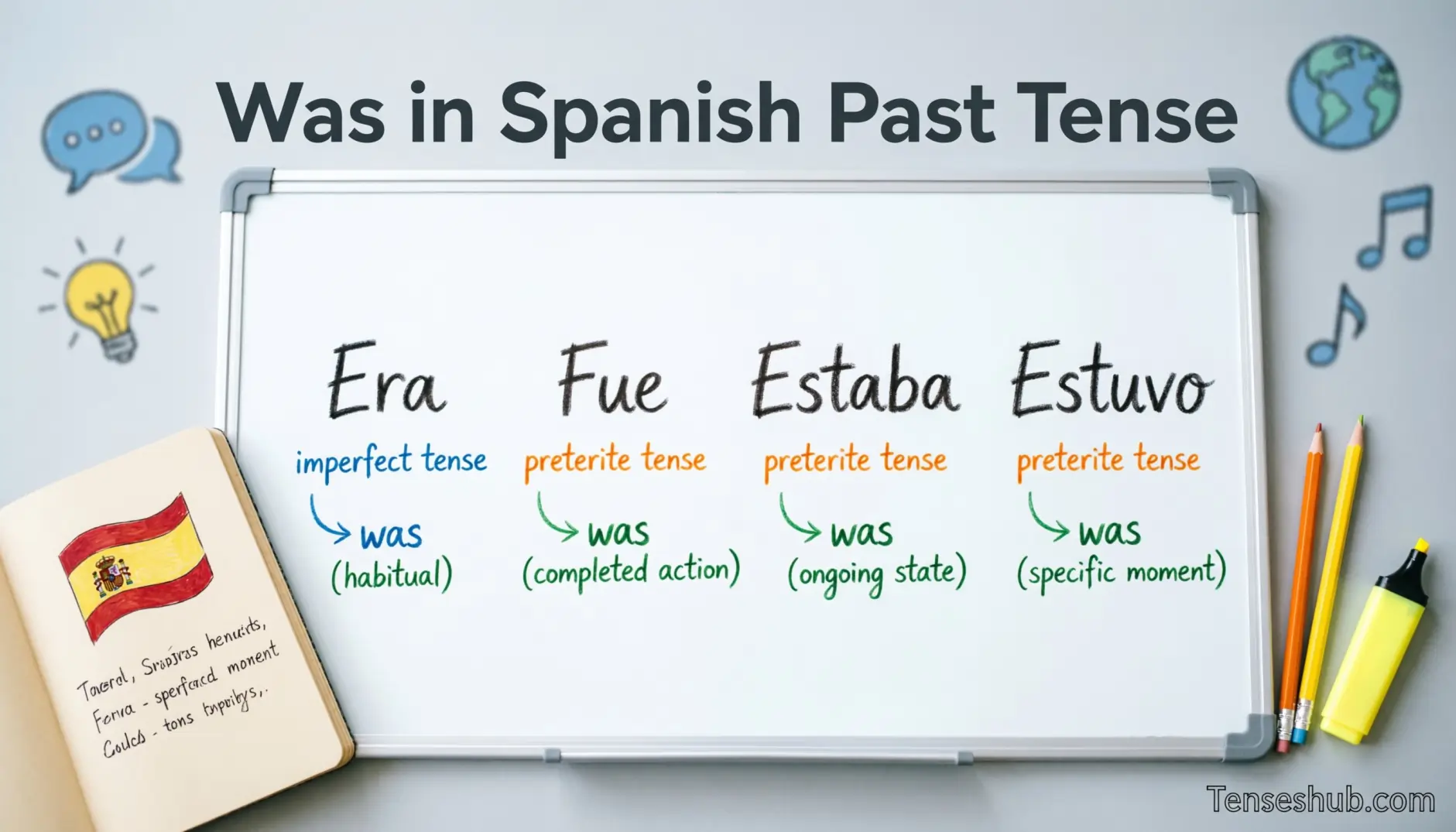
- Era = was (description, background, characteristics)
- Fue = was (completed event or identity)
- Estaba = was (temporary condition or location)
- Estuvo = was (temporary condition completed in the past)
What Is Was in Spanish Past Tense?
In English grammar, “was” is the past tense form of the verb “to be.”
Examples:
- I was tired.
- She was happy.
- He was at school.
In Spanish, there are two verbs that can mean “to be”:
- Ser
- Estar
Because of this, Spanish offers multiple ways to translate “was.”
Using Ser
The verb ser describes:
- Identity
- Characteristics
- Occupation
- Origin
- Time
- Permanent qualities
Examples:
- Ella era inteligente.
(She was intelligent.) - Él fue profesor.
(He was a teacher.)
Using Estar
The verb estar describes:
- Location
- Temporary conditions
- Emotions
- Physical states
Examples:
- Yo estaba cansado.
(I was tired.) - Ella estuvo enferma.
(She was sick.)
Understanding if you need ser or estar is the first step to using “was” correctly in Spanish.
Structure of Sentences of Was in Spanish Past Tense
Spanish sentence order is usually straightforward.
Affirmative Structure
Subject + was form + complement
Examples:
- Yo era estudiante.
- Ella estaba feliz.
- Él fue médico.
Negative Structure
Subject + no + was form + complement
Examples:
- Yo no era estudiante.
- Ella no estaba feliz.
- Él no fue médico.
Interrogative Structure
¿Was form + subject + complement?
Examples:
- ¿Era ella tu amiga?
- ¿Estaba él en casa?
- ¿Fue ella la ganadora?
Spanish often omits the subject because the verb already shows who is performing the action.
Example:
- ¿Era estudiante?
- ¿Estaba cansado?
Formation of Was in Spanish Past Tense
Since “was” comes from either ser or estar, you must learn their past forms.
Imperfect Forms
These forms describe ongoing situations, descriptions, habits, or background information.
Ser (Imperfect)
| Subject | Form |
|---|---|
| Yo | era |
| Tú | eras |
| Él / Ella | era |
| Nosotros / Nosotras | éramos |
| Vosotros / Vosotras | erais |
| Ellos / Ellas | eran |
Estar (Imperfect)
| Subject | Form |
|---|---|
| Yo | estaba |
| Tú | estabas |
| Él / Ella | estaba |
| Nosotros / Nosotras | estábamos |
| Vosotros / Vosotras | estabais |
| Ellos / Ellas | estaban |
Preterite Forms
These forms describe completed actions or specific past events.
How to Use Was in Spanish Past Tense
The correct choice depends on what you want to express.
Use Era for Descriptions
Use era when talking about characteristics, identity, or background information.
Examples:
- Mi abuelo era amable.
(My grandfather was kind.) - La casa era grande.
(The house was big.) - Era una noche fría.
(It was a cold night.)
Use Fue for Completed Facts or Events
Use fue when describing something completed in the past.
Examples:
- La reunión fue interesante.
(The meeting was interesting.) - Él fue mi profesor.
(He was my teacher.) - Fue un gran día.
(It was a great day.)
Use Estaba for Temporary Conditions
Use estaba for emotions, feelings, and locations.
Examples:
- Estaba cansado.
(I was tired.) - Ella estaba en casa.
(She was at home.) - El niño estaba triste.
(The child was sad.)
Use Estuvo for Completed Temporary States
Use estuvo when the temporary state occurred and ended.
Examples:
- Estuvo enfermo tres días.
(He was sick for three days.) - Ella estuvo en Madrid una semana.
(She was in Madrid for one week.) - Estuvo ocupado toda la mañana.
(He was busy all morning.)
Structure / Verb Pattern Table
| Meaning of “Was” | Spanish Form | Example |
|---|---|---|
| Description | Era | Ella era amable. |
| Background information | Era | Era una tarde bonita. |
| Completed event (Ser) | Fue | La fiesta fue divertida. |
| Temporary condition | Estaba | Yo estaba cansado. |
| Temporary location | Estaba | Él estaba en casa. |
| Completed temporary state (Estar) | Estuvo | Estuvo enfermo dos días. |
Real Life Examples
Here are practical examples of was in Spanish past tense.
Affirmative Sentences
- Yo era estudiante.
- Ella estaba cansada.
- Él fue médico.
- Mi hermano estuvo enfermo.
- La película fue excelente.
Negative Sentences
- Yo no era profesor.
- Ella no estaba en casa.
- Él no fue el ganador.
- Nosotros no estuvimos allí.
Questions
- ¿Era ella tu hermana?
- ¿Estaba él cansado?
- ¿Fue una buena idea?
- ¿Estuvo enferma la semana pasada?
Informal Examples
- Estaba muy feliz ayer.
- Fue una fiesta increíble.
- Era mi mejor amigo.
Formal Examples
- El evento fue exitoso.
- La conferencia fue importante.
- El director estuvo presente.
Common Mistakes
Mistake 1: Using Fue Instead of Era
❌ Ella fue inteligente.
✅ Ella era inteligente.
Why? Intelligence is a characteristic, so use era.
Mistake 2: Using Era for Temporary Feelings
❌ Yo era cansado.
✅ Yo estaba cansado.
Why? Tiredness is temporary.
Mistake 3: Using Estaba for Identity
❌ Él estaba médico.
✅ Él era médico.
Why? Occupations use ser.
Mistake 4: Confusing Estaba and Estuvo
❌ Estuvo cansado cuando llegué.
✅ Estaba cansado cuando llegué.
Why? The condition was ongoing at that moment.
Mistake 5: Translating Every “Was” the Same Way
❌ One Spanish word for every sentence.
✅ Choose the form according to the meaning.
Key Grammar Rules
Rule 1
Use ser for identity and characteristics.
Example:
- Ella era doctora.
Rule 2
Use estar for emotions and physical conditions.
Example:
- Yo estaba nervioso.
Rule 3
Use the imperfect (era, estaba) for descriptions and ongoing situations.
Example:
- Era un día soleado.
Rule 4
Use the preterite (fue, estuvo) for completed past situations.
Example:
- La reunión fue corta.
Rule 5
Location generally uses estar.
Example:
- Ella estaba en la oficina.
Rule 6
Occupations use ser.
Example:
- Mi padre era ingeniero.
Comparisons with Similar Grammar Forms
Era vs Fue
| Era | Fue |
|---|---|
| Description | Completed event |
| Background information | Specific completed fact |
| Ongoing past state | Finished past action |
Examples:
- Era amable. (He was kind.)
- Fue amable conmigo. (He was kind to me on that occasion.)
Estaba vs Estuvo
| Estaba | Estuvo |
|---|---|
| Ongoing condition | Completed condition |
| Background situation | Finished situation |
Examples:
- Estaba enfermo cuando llamaste.
- Estuvo enfermo tres días.
Ser vs Estar
| Ser | Estar |
|---|---|
| Identity | Condition |
| Characteristics | Emotions |
| Occupation | Location |
Examples:
- Era profesor.
- Estaba en la escuela.
Exercises
Exercise 1: Fill in the Blanks
Choose the correct form.
- Ella _____ feliz ayer. (estaba / era)
- La fiesta _____ divertida. (fue / estaba)
- Mi abuelo _____ muy amable. (era / estuvo)
- Yo _____ enfermo dos días. (estuve / era)
- Él _____ en casa. (estaba / fue)
Exercise 2: Correct the Mistakes
- Ella estaba doctora.
- Yo era cansado.
- La película estaba excelente.
- Él fue enfermo.
- Nosotros estuvimos estudiantes.
Exercise 3: Rewrite in Spanish
- She was tired.
- He was a teacher.
- The meeting was interesting.
- I was at home.
- They were happy.
Exercise 4: Multiple Choice
- Which form means “was” for a temporary condition?
A. Era
B. Fue
C. Estaba
D. Fui
- Which sentence is correct?
A. Ella estaba profesora.
B. Ella era profesora.
C. Ella estuvo profesora.
D. Ella fue cansada.
Answer Key
Exercise 1
- estaba
- fue
- era
- estuve
- estaba
Exercise 2
- Ella era doctora.
- Yo estaba cansado.
- La película fue excelente.
- Él estuvo enfermo.
- Nosotros éramos estudiantes.
Exercise 3
- Ella estaba cansada.
- Él era profesor.
- La reunión fue interesante.
- Yo estaba en casa.
- Ellos estaban felices.
Exercise 4
- C
- B
FAQs
What is “was” in Spanish?
There is no single Spanish word for “was.” Common translations include era, fue, estaba, and estuvo.
Is “era” the same as “fue”?
No. Era describes background information or characteristics, while fue refers to completed events or facts.
When should I use “estaba”?
Use estaba for temporary conditions, emotions, and locations in the past.
What is the difference between “estaba” and “estuvo”?
Estaba describes an ongoing past state, while estuvo describes a completed temporary state.
Why does Spanish have different words for “was”?
Spanish uses two verbs meaning “to be” (ser and estar) and different past tenses, creating multiple translations for “was.”
Is “fue” always translated as “was”?
Not always. Depending on context, it can mean was, went, or other related meanings.
Conclusion
Learning was in Spanish past tense can seem difficult at first because Spanish does not use a single word for every situation. Instead, you must choose between era, fue, estaba, and estuvo based on meaning and context.
The key is remembering that ser is usually used for identity, characteristics, and descriptions, while estar is used for locations, emotions, and temporary conditions.
As you practice reading, writing, and speaking Spanish, these differences will become more natural. Focus on understanding why a speaker chooses a specific form rather than simply memorizing translations.
With regular practice and real life examples, you’ll soon feel confident using Spanish past tense forms accurately and naturally in everyday conversations.

Hi, I’m Noah Bester, a tenses expert passionate about simplifying English grammar. I create practical, easy-to-understand guides to help learners master tenses with confidence. My goal is to make grammar clear, useful, and applicable in everyday communication. tenseshub.com