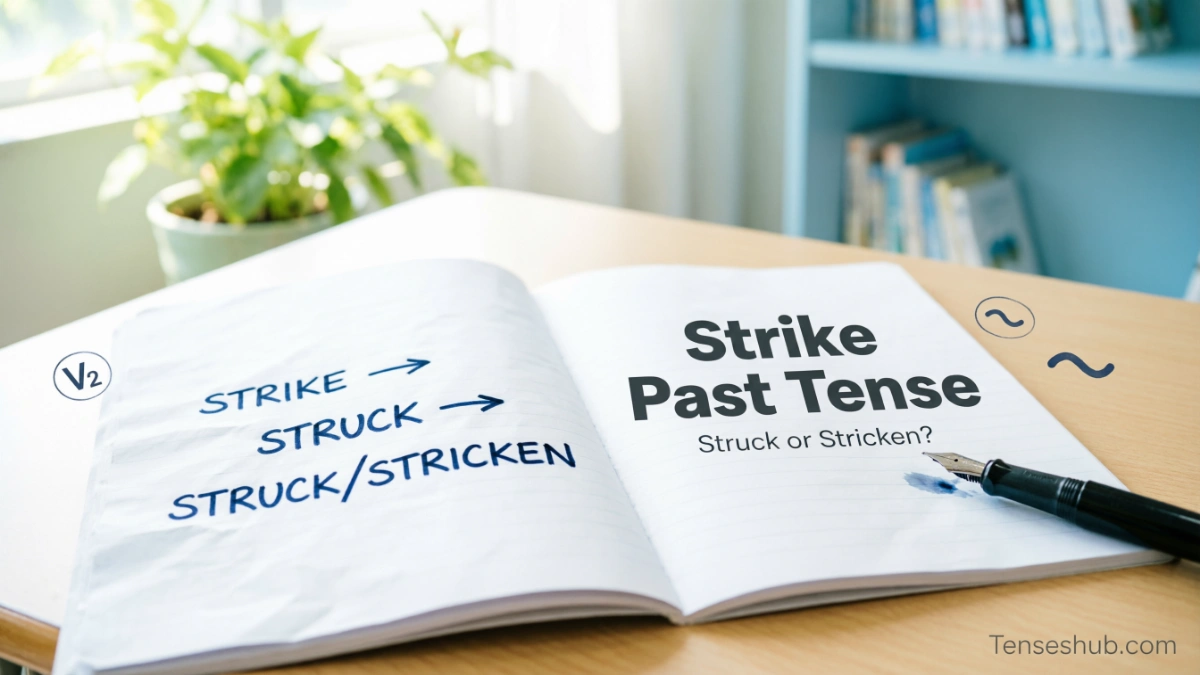
Have you ever wondered if the strike past Have you ever wondered whether the past tense of strike is struck or striked? You are not alone. Many English learners find this verb confusing because strike is an irregular verb and does not follow the regular -ed pattern.
The correct strike past tense is struck, not striked. The word strike has several meanings, so its forms can sometimes be confusing, especially when you see struck and stricken used in different situations.
The past participle of strike can also be struck. However, stricken is used in certain meanings and expressions, particularly when someone or something is seriously affected by a problem, disease, disaster, or difficult situation.
Learning the different forms of strike is important for using the verb correctly in both everyday and formal English. Knowing when to use struck and stricken can also help you avoid common grammar mistakes.
In this guide, you will learn the strike past tense, past participle, complete verb forms, meanings, sentence patterns, struck vs. stricken, common mistakes, and easy rules for using strike correctly.
Quick Answer (Featured Snippet)
The past tense of strike is usually “struck.” The past participle can be struck or, in certain meanings, stricken.
| Verb Form | Word |
|---|---|
| V1 – Base | strike |
| V2 – Past | struck |
| V3 – Past Participle | struck / stricken |
| -ing Form | striking |
Example: The boxer struck his opponent.
What Is Strike Past Tense?
The strike past tense is struck.
Strike is an irregular verb. This means we do not normally make its past tense by adding ed. Instead, the verb changes from strike to struck.
Strike verb forms
The main forms of strike are:
- V1: strike
- V2: struck
- V3: struck / stricken
- V4: striking
- V5: strikes
Here are the forms in simple sentences:
- Present: I strike the ball.
- Past: I struck the ball.
- Past participle: I have struck the ball.
- ing form: I am striking the ball.
- Third person singular: He strikes the ball.
The word strike has several meanings. It can mean to hit something, suddenly affect someone or something, begin a protest by stopping work, remove something, or make an agreement or discovery.
Because the meaning can change, the choice between struck and stricken sometimes depends on context.
Structure of Sentences of Strike Past Tense
When strike is used in the simple past, the main verb is struck.
Affirmative sentences
Subject + struck + object/complement
Examples:
- She struck the ball.
- He struck the table.
- The player struck the ball hard.
- Lightning struck the building.
Negative sentences
Subject + did not + strike + object/complement
Notice that after did not, we use the base form strike, not struck.
Examples:
- She did not strike the ball.
- He did not strike the table.
- They did not strike the target.
Interrogative sentences
Did + subject + strike + object/complement?
Examples:
- Did she strike the ball?
- Did he strike the target?
- Did lightning strike the building?
Short answers
- Did he strike the ball? — Yes, he did.
- Did she strike the target? — No, she didn’t.
Formation of Strike Past Tense
The simple past form of strike is struck.
Unlike regular verbs such as walk → walked or play → played, strike does not take ed to form its simple past.
Main verb forms
| Form | Verb |
|---|---|
| Base form (V1) | strike |
| Simple past (V2) | struck |
| Past participle (V3) | struck / stricken |
| Present participle | striking |
| Third-person singular | strikes |
Why not “striked”?
Striked is generally incorrect when you mean the ordinary past tense of strike.
Incorrect:
- ❌ He striked the ball.
Correct:
- ✅ He struck the ball.
The irregular change is:
strike → struck
Past participle: struck or stricken?
This is where many learners become confused.
Struck is commonly used as the past participle:
- She has struck the ball.
- The storm has struck the coast.
Stricken is also a past participle, but it is especially common in particular meanings and expressions:
- The country was stricken by famine.
- He was stricken with grief.
- The area was stricken by disease.
In many ordinary situations involving hitting or physically striking something, struck is the natural choice.
The ing form
The present participle is striking:
- He is striking the ball.
- The machine is striking the metal.
Do not write strikeing.
Correct spelling:
strike → striking
The final e is dropped before ing.
How to Use Strike Past Tense
The past tense struck is used when an action involving strike happened in the past.
1. To mean “hit”
One of the most common meanings of strike is to hit something or someone.
Examples:
- The player struck the ball with his racket.
- He struck the wall with his hand.
- The hammer struck the nail.
- The boxer struck his opponent.
Here, struck describes a completed past action.
2. To describe a natural event
Strike is often used when something such as lightning, an earthquake, or a storm suddenly affects a place.
Examples:
- Lightning struck the tree.
- A powerful earthquake struck the region.
- A major storm struck the city last night.
This usage is especially common in news reports and formal writing.
3. To mean “affect suddenly”
Strike can also describe something that suddenly affects a person or group.
Examples:
- The news struck everyone as a surprise.
- Fear struck him suddenly.
- The illness struck the family unexpectedly.
4. To mean “remove” or “delete”
In some contexts, strike means to remove something from a document, list, or record.
Examples:
- The editor struck the sentence from the article.
- The judge struck the evidence from the record.
- The company struck his name from the list.
5. To mean “begin a workers’ protest”
The verb strike is also used when workers stop working as a form of protest.
Examples:
- The workers struck for better pay.
- The employees struck last week.
- Thousands of workers struck against the new policy.
Here, struck does not mean “hit.” It means went on strike.
6. To describe making an agreement or finding something
In formal English, strike can mean to make an agreement or establish something.
Examples:
- The two companies struck a deal.
- The countries struck an agreement.
- The researchers struck upon an interesting idea.
This meaning is common in formal and professional writing.
Strike Verb Pattern Table
| Situation | Pattern | Example |
|---|---|---|
| Simple past | Subject + struck + object | She struck the ball. |
| Negative past | Subject + did not + strike | She did not strike the ball. |
| Past question | Did + subject + strike? | Did she strike the ball? |
| Present perfect | have/has + struck | He has struck the target. |
| Past perfect | had + struck | He had struck the ball before it fell. |
| Passive | was/were + struck | The tree was struck by lightning. |
| -ing form | am/is/are + striking | He is striking the ball |
Real Life Examples
Here are different examples showing how struck works in everyday, academic, professional, and formal English.
Everyday examples
- The boy struck the ball with a bat.
- She struck the table in anger.
- The hammer struck the nail.
- He struck the door with his hand.
Weather and natural events
- Lightning struck the old tree.
- A strong storm struck the coast yesterday.
- The earthquake struck the region during the night.
- A powerful hurricane struck the island.
Work and business
- The workers struck for higher wages.
- The two companies struck a deal.
- The managers struck an agreement after several meetings.
- The team struck a balance between quality and cost.
Formal writing
- The judge struck the statement from the record.
- The editor struck several unnecessary sentences.
- The disease struck the community unexpectedly.
Negative sentences
- The player did not strike the ball correctly.
- The workers did not strike that year.
- Lightning did not strike the house.
Questions
- Did the player strike the ball?
- Did the storm strike the city?
- Did the workers strike last month?
Common Mistakes
Mistake 1: Using “striked” as the past tense
Incorrect:
- ❌ He striked the ball.
Correct:
- ✅ He struck the ball.
Why? Strike is an irregular verb, so its past form is struck.
Mistake 2: Using “struck” after “did”
Incorrect:
- ❌ Did he struck the ball?
Correct:
- ✅ Did he strike the ball?
After did, use the base form of the verb.
Mistake 3: Using “struck” after “didn’t”
Incorrect:
- ❌ She didn’t struck him.
Correct:
- ✅ She didn’t strike him.
The helping verb did already marks the past tense.
Mistake 4: Confusing “strike” and “stricken”
Incorrect in many ordinary contexts:
- ❌ He has stricken the ball.
Better:
- ✅ He has struck the ball.
However, stricken is correct in certain expressions:
- The nation was stricken by famine.
- She was stricken with grief.
Mistake 5: Spelling the ing form as “strikeing”
Incorrect:
- ❌ He is strikeing the ball.
Correct:
- ✅ He is striking the ball.
The final e is removed before ing.
Mistake 6: Confusing “strike” with “hit”
Strike and hit can have similar meanings, but their verb forms are different.
- hit → hit → hit
- strike → struck → struck
So:
- He hit the ball yesterday.
- He struck the ball yesterday.
Both can be correct, depending on the intended style and context.
Key Grammar Rules
Here are the most important rules to remember about strike.
Rule 1: The simple past of strike is struck
Strike → struck
Example:
- The player struck the ball.
Rule 2: Do not normally use “striked”
For standard English, use struck, not striked, when forming the simple past.
- ❌ She striked the ball.
- ✅ She struck the ball.
Rule 3: Use “strike” after did
After did or didn’t, use the base form.
- Did he strike the ball?
- He didn’t strike the ball.
Rule 4: Struck and stricken can both be past participles
Struck is widely used:
- The storm has struck the coast.
Stricken is especially common with certain meanings and expressions:
- He was stricken with grief.
Rule 5: The ing form is striking
The spelling is:
strike → striking
Example:
- The player is striking the ball.
Rule 6: The meaning of strike depends on context
Strike can mean hit, affect suddenly, remove, go on strike, or make an agreement.
For example:
- He struck the ball. = hit
- The storm struck the city. = affected suddenly
- The workers struck. = stopped working as a protest
Comparisons with Similar Grammar Forms
Strike vs Struck
Strike is the base form. Struck is the simple past form.
- Present: They strike the ball.
- Past: They struck the ball.
Do not use strike by itself to describe a completed simple past action.
Struck vs Stricken
Both can function as past participles, but they are not always interchangeable.
Struck is common for the general meaning of hitting and many other meanings:
- The ball was struck by the player.
- The storm has struck the region.
Stricken is particularly common when something or someone is seriously affected:
- He was stricken with grief.
- The country was stricken by famine.
- The town was stricken by disease.
A useful beginner rule is:
For ordinary past actions, remember strike → struck. Learn stricken as a special past participle form used in particular contexts.
Strike vs Hit
Both verbs can mean “to hit.”
| Verb | Past | Past Participle |
|---|---|---|
| strike | struck | struck / stricken |
| hit | hit | hit |
Examples:
- He struck the ball.
- He hit the ball.
Hit is very common in everyday English, while strike can sound more formal or specific depending on the context.
Strike vs Attack
Strike can sometimes describe a physical attack, but it does not always mean “attack.”
- The boxer struck his opponent.
- The soldiers attacked the enemy.
Strike can focus on a particular blow or sudden action, while attack generally describes an act of aggression.
Struck vs Struck by
The expression struck by is common when something affects or hits a person or place.
Examples:
- The town was struck by a storm.
- She was struck by the beauty of the view.
- The building was struck by lightning.
The meaning depends on the noun or phrase that follows.
Exercises
Exercise 1: Fill in the blanks
Complete each sentence with strike, struck, or striking.
- The player ______ the ball yesterday.
- Did the boxer ______ his opponent?
- Lightning ______ the tree last night.
- He is ______ the metal with a hammer.
- They did not ______ the target.
- The storm ______ the city two days ago.
Exercise 2: Choose the correct answer
1. What is the past tense of “strike”?
A. Striked
B. Struck
C. Strike
D. Striken
2. Which sentence is correct?
A. She did not struck the ball.
B. She did not strike the ball.
C. She did not striked the ball.
D. She did not striking the ball.
3. Which form is commonly used after “has”?
A. strike
B. striking
C. struck
D. strikes
4. Which sentence correctly uses “stricken”?
A. He stricken the ball yesterday.
B. He has stricken the ball.
C. The country was stricken by famine.
D. Did she stricken the target?
Exercise 3: Correct the mistakes
Rewrite each sentence correctly.
- He striked the ball.
- Did she struck the table?
- They didn’t struck the target.
- The workers striked last month.
- He is strikeing the drum.
Exercise 4: Rewrite the sentences
Change each sentence into a negative sentence.
- The player struck the ball.
- Lightning struck the tree.
- The workers struck for better wages.
Then change each sentence into a question.
Answer Key
Exercise 1
- struck
- strike
- struck
- striking
- strike
- struck
Exercise 2
- B. Struck
- B. She did not strike the ball.
- C. Struck
- C. The country was stricken by famine.
Exercise 3
- He struck the ball.
- Did she strike the table?
- They didn’t strike the target.
- The workers struck last month.
- He is striking the drum.
Exercise 4
Negative:
- The player did not strike the ball.
- Lightning did not strike the tree.
- The workers did not strike for better wages.
Questions:
- Did the player strike the ball?
- Did lightning strike the tree?
- Did the workers strike for better wages?
FAQs
What is the past tense of strike?
The past tense of strike is struck.
Example: The player struck the ball.
Is “striked” the past tense of strike?
No. In standard English, the simple past is struck, not striked.
What are the three forms of strike?
The main three forms are:
strike – struck – struck
Stricken is also used as a past participle in certain meanings and expressions.
Is the past participle of strike “struck” or “stricken”?
Both struck and stricken can be past participles. Struck is common in many ordinary uses, while stricken is especially common when describing someone or something seriously affected.
Is “stricken” grammatically correct?
Yes. Stricken is a correct form of strike, but it is not interchangeable with struck in every sentence.
Example:
- The country was stricken by famine.
What is the past tense of “strike” in a sentence?
Example:
The workers struck last week.
Here, struck is the simple past form.
Do we say “Did he strike” or “Did he struck”?
Say “Did he strike?”
After did, always use the base form:
- ✅ Did he strike?
- ❌ Did he struck?
What is the past participle of strike?
The past participle can be struck or stricken, depending on the meaning and construction.
What is the past continuous form of strike?
The past continuous uses was/were + striking.
Examples:
- He was striking the drum.
- They were striking the metal.
What is the present tense of struck?
The base form is strike.
For example:
- I strike the ball.
- He strikes the ball.
Conclusion
The most important thing to remember about the strike past tense is simple: strike → struck. The word striked is not the standard simple past form.
The verb strike is irregular and has several meanings. It can mean to hit something, affect someone suddenly, remove something, stop working as a protest, or make an agreement. Its past participle is commonly struck, while stricken is also correct in certain expressions and meanings.
Remember these core forms:
strike – struck – struck/stricken – striking
Also remember that after did or didn’t, you must return to the base form strike: “Did he strike?” and “He didn’t strike.”
The best way to master this verb is to practice it in complete sentences rather than memorizing the forms alone. With regular practice, strike, struck, and stricken will become much easier to use correctly.