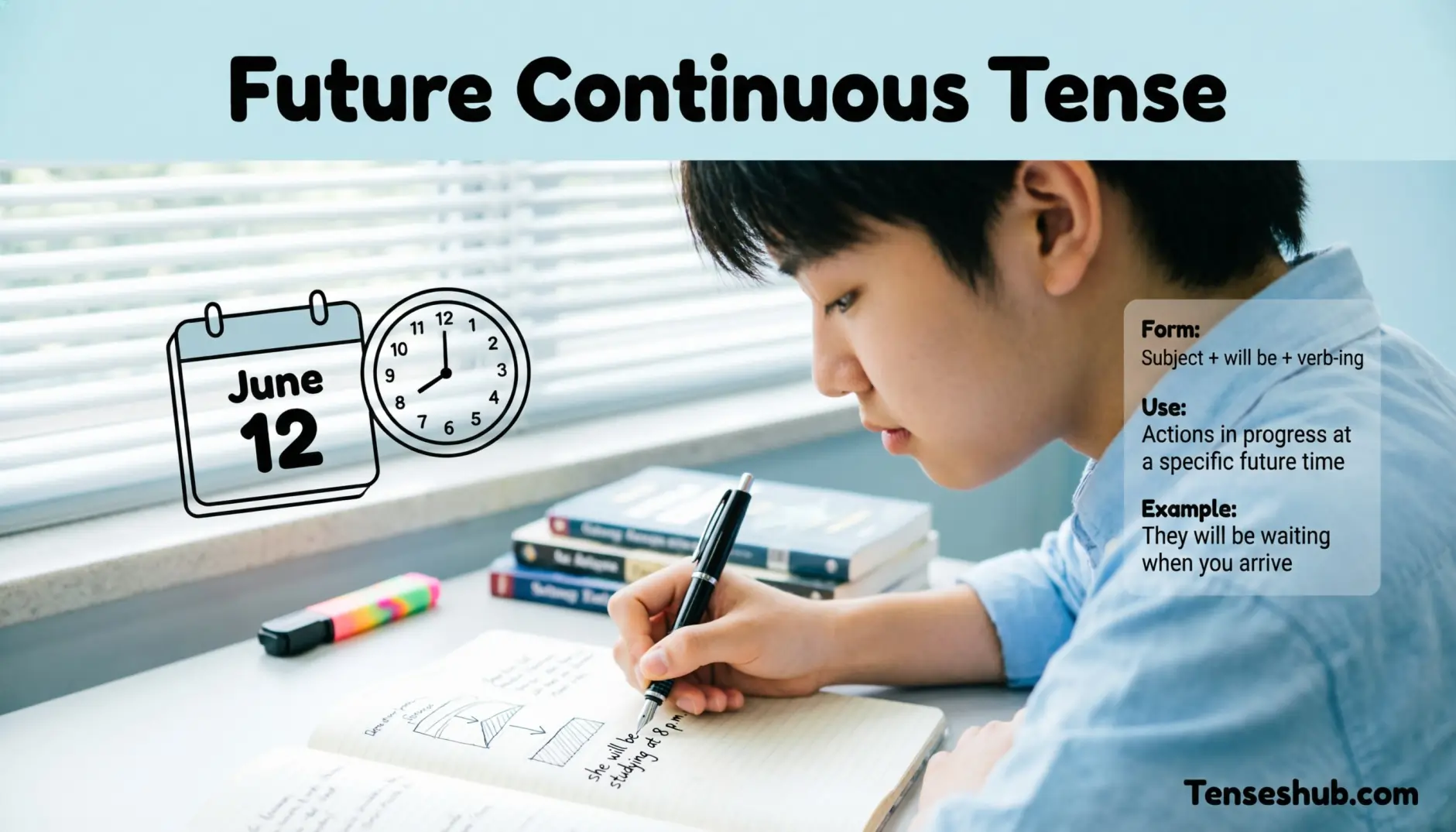
Have you ever wanted to talk about something that will be happening at a specific time in the future? For example, “I will be studying at 8 PM” or “They will be traveling next week.”
Many English learners understand the future tense but get confused when they need to describe an action that will be in progress at a future moment.
This is where the future continuous tense becomes useful. It helps us talk about ongoing actions that will be happening in the future.
If you are writing emails, speaking in conversations, preparing for exams, or improving your English grammar, understanding this tense can make your communication clearer and more natural.
In this guide, you will learn the meaning, structure, formation, rules, examples, common mistakes, comparisons, and practice exercises related to the future continuous tense in a simple and beginner friendly way.
Quick Answer (Featured Snippet)
The future continuous tense is used to describe an action that will be in progress at a specific time in the future.
Formula
| Structure |
|---|
| Subject + will be + verb (-ing) |
Example: I will be working at 10 AM tomorrow.
What Is Future Continuous Tense?
The future continuous tense (also called the future progressive tense) describes an action that will be ongoing at a particular time in the future.
Instead of focusing on when an action starts or ends, it focuses on the action being in progress.
Examples
- I will be reading a book tonight.
- She will be driving to work at 8 AM.
- They will be playing football tomorrow afternoon.
Function of Future Continuous Tense
The future continuous tense is used to:
- Describe an action that will be happening in the future.
- Show that an activity will be in progress at a certain future time.
- Talk about planned future events.
- Ask polite questions about someone’s future plans.
Example
- At 9 PM, I will be watching a movie.
The action of watching is ongoing at that future time.
Structure of Sentences of Future Continuous Tense
Affirmative Sentences
Formula:
Subject + will be + verb ing
Examples:
- I will be studying tonight.
- She will be working tomorrow.
- They will be traveling next month.
Negative Sentences
Formula:
Subject + will not be + verb ing
Examples:
- I will not be sleeping early.
- He will not be attending the meeting.
- We will not be watching television.
Interrogative Sentences
Formula:
Will + subject + be + verb ing?
Examples:
- Will you be coming tomorrow?
- Will she be working late?
- Will they be staying here?
Formation of Future Continuous Tense
The future continuous tense is formed using three parts:
- Will
- Be
- Present participle (verb + ing)
Basic Formula
Will + be + verb ing
Examples
- work → will be working
- play → will be playing
- study → will be studying
- read → will be reading
Contractions in Future Continuous Tense
In informal English, contractions are commonly used to make sentences sound more natural and conversational.
| Full Form | Contraction |
|---|---|
| I will be | I’ll be |
| You will be | You’ll be |
| He will be | He’ll be |
| She will be | She’ll be |
| It will be | It’ll be |
| We will be | We’ll be |
| They will be | They’ll be |
Adding “ ing” to Verbs
Most verbs simply take ing.
- play → playing
- work → working
- learn → learning
Verbs Ending in “e”
Drop the final e before adding ing.
- make → making
- write → writing
- take → taking
Double the Final Consonant (When Needed)
- run → running
- sit → sitting
- swim → swimming
Irregular Verbs
Unlike past tenses, irregular verbs do not change here because the main verb always takes the ing form.
- go → going
- eat → eating
- come → coming
How to Use Future Continuous Tense
1. Actions in Progress at a Specific Future Time
Use it when an action will be happening at a certain moment.
Examples:
- At 7 PM, I will be cooking dinner.
- Tomorrow morning, she will be driving to school.
2. Future Activities That Are Already Planned
It can describe expected future activities.
Examples:
- We will be staying at a hotel next weekend.
- They will be attending the conference next month.
3. Polite Questions About Future Plans
This tense often sounds more polite than the simple future tense.
Examples:
- Will you be using the car tonight?
- Will you be joining us for dinner?
4. Simultaneous Future Actions
Two actions may happen at the same future time.
Examples:
- While you are working, I will be studying.
- She will be sleeping while we are traveling.
5. Predicting Ongoing Future Events
Examples:
- This time tomorrow, we will be flying to Dubai.
- Next week, many students will be preparing for exams.
Future Continuous Structure or Verb Pattern Table
| Sentence Type | Structure |
|---|---|
| Affirmative | Subject + will be + V-ing |
| Negative | Subject + will not be + V-ing |
| Interrogative | Will + subject + be + V-ing? |
| WH Question | WH word + will + subject + be + V-ing? |
| Short Answer (Yes) | Yes, subject + will |
| Short Answer (No) | No, subject + will not |
Real Life Examples
Daily Life
- I will be exercising at 6 AM tomorrow.
- My brother will be studying for his test tonight.
Workplace
- We will be discussing the project tomorrow.
- The manager will be meeting clients in the afternoon.
Travel
- They will be flying to London next week.
- I will be staying with relatives during my trip.
School
- The students will be taking exams next month.
- She will be attending classes online.
Informal Conversation
- I’ll be watching the match tonight.
- We’ll be hanging out after school.
Questions
- Will you be working this weekend?
- Will they be coming to the party?
Negative Sentences
- She will not be driving today.
- We will not be staying there overnight.
Common Mistakes
Mistake 1: Forgetting “be”
❌ I will studying tomorrow.
✅ I will be studying tomorrow.
Explanation: Future continuous always requires will be.
Mistake 2: Using the Base Verb Instead of ing Form
❌ She will be work tomorrow.
✅ She will be working tomorrow.
Explanation: The main verb must end in ing.
Mistake 3: Using Past Tense After “Will Be”
❌ They will be played football.
✅ They will be playing football.
Explanation: Use the present participle, not the past tense.
Mistake 4: Incorrect Question Structure
❌ Will be you studying tonight?
✅ Will you be studying tonight?
Explanation: The subject comes after “will”.
Mistake 5: Using Future Continuous for Completed Actions
❌ I will be finish the report tomorrow.
✅ I will finish the report tomorrow.
Explanation: Future continuous shows an ongoing action, not a completed one.
Key Grammar Rules
Rule 1
Always use will be before the main verb.
- She will be working late.
Rule 2
The main verb must be in the ing form.
- They will be traveling tomorrow.
Rule 3
All subjects use the same helping verb.
- I will be studying.
- He will be studying.
- They will be studying.
Rule 4
Use future time expressions when appropriate.
- tomorrow
- next week
- at 8 PM
- this time tomorrow
Rule 5
Future continuous emphasizes the process, not completion.
- At noon, I will be working.
Rule 6
Use it for polite questions about plans.
- Will you be attending the meeting?
Comparisons with Similar Grammar Forms
Future Continuous vs Simple Future
Simple Future
Focuses on a future action.
- I will study tonight.
Future Continuous
Focuses on an ongoing future action.
- I will be studying tonight.
Future Continuous vs Future Perfect
Future Continuous
- I will be working at 8 PM.
Future Perfect
- I will have finished work by 8 PM.
The future continuous focuses on an action in progress, while the future perfect focuses on completion.
Future Continuous vs Present Continuous
Present Continuous
- I am studying now.
Future Continuous
- I will be studying tomorrow evening.
The present continuous refers to the present, while the future continuous refers to the future.
Future Continuous vs Future Perfect Continuous
Future Continuous
- She will be teaching at 10 AM.
Future Perfect Continuous
- She will have been teaching for three hours by 10 AM.
The future perfect continuous emphasizes duration.
Exercises
Exercise 1: Fill in the Blanks
Complete the sentences using the future continuous tense.
- She _____ (study) tonight.
- We _____ (travel) next week.
- They _____ (play) football tomorrow afternoon.
- I _____ (work) at 8 PM.
- He _____ (drive) to the airport.
Exercise 2: Correct the Sentences
- I will studying tomorrow.
- She will be write a report.
- Will be they coming today?
- We will be watched television.
- He will not be drive home.
Exercise 3: Rewrite in Future Continuous
- I work at 9 PM tomorrow.
- She reads a book tonight.
- They travel next week.
- We play cricket tomorrow.
- He attends a meeting tomorrow morning.
Exercise 4: Multiple Choice Questions
1. Which sentence is correct?
A. I will be study tomorrow.
B. I will studying tomorrow.
C. I will be studying tomorrow.
D. I be studying tomorrow.
2. Which helping verbs are used in future continuous tense?
A. am/is/are
B. has/have
C. will be
D. had been
3. Which sentence is a question?
A. She will be working.
B. Will she be working?
C. She will working.
D. She be working.
4. Which sentence is negative?
A. They will be traveling.
B. They will traveling.
C. They will not be traveling.
D. Will they be traveling?
Answer Key
Exercise 1
- will be studying
- will be traveling
- will be playing
- will be working
- will be driving
Exercise 2
- I will be studying tomorrow.
- She will be writing a report.
- Will they be coming today?
- We will be watching television.
- He will not be driving home.
Exercise 3
- I will be working at 9 PM tomorrow.
- She will be reading a book tonight.
- They will be traveling next week.
- We will be playing cricket tomorrow.
- He will be attending a meeting tomorrow morning.
Exercise 4
- C
- C
- B
- C
FAQs
What is the future continuous tense?
It is a tense used to describe an action that will be happening at a specific time in the future.
What is the formula of future continuous tense?
Subject + will be + verb ing
Example: She will be working tomorrow.
Can I use “shall be” instead of “will be”?
Traditionally, “shall” was used with “I” and “we,” but modern English mainly uses will be for all subjects.
Why do we use the ing form?
The ing form shows that the action is ongoing or in progress.
Is future continuous the same as future perfect?
No. Future continuous shows an action in progress, while future perfect shows an action completed before a future time.
Can future continuous be used in questions?
Yes.
Example:
- Will you be attending the meeting?
What are common time expressions used with future continuous?
Examples include:
- tomorrow
- next week
- at 8 PM
- this time tomorrow
- next month
Conclusion
The future continuous tense is an important part of English grammar because it helps us describe actions that will be happening at a specific time in the future.
The basic formula is simple: subject + will be + verb ing. Once you understand this pattern, you can easily create affirmative, negative, and interrogative sentences.
This tense is especially useful when discussing schedules, future plans, ongoing future activities, and polite questions. Remember to always use will be and the ing form of the main verb. Regular practice with real life examples and exercises will help you use the future continuous tense naturally and confidently.
Keep practicing by creating your own future continuous sentences about tomorrow, next week, or future plans. The more you use it, the more comfortable and fluent your English will become
Hi, I’m Robert Lowth, a passionate expert in English tenses and grammar. I specialize in simplifying complex tense rules to help learners understand and use English with confidence. My goal is to make grammar clear, practical, and easy for everyday communication. tenseshub.com









