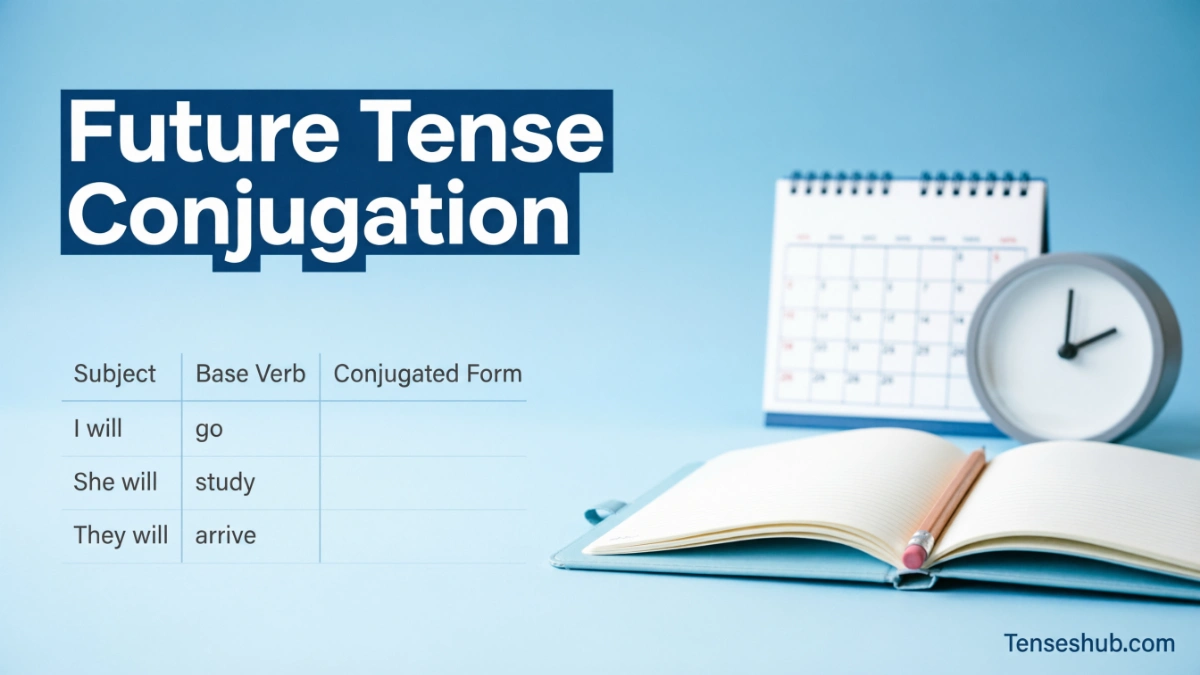
Have you ever wondered if you should say “I will go,” “she is going to study,” or “they will be working”? If so, you’re not alone.
Many English learners get confused about future tense conjugation because English has several ways to talk about future events instead of one simple future tense.
Learning future tense conjugation helps you speak and write about plans, predictions, promises, schedules, and future actions correctly.
If you’re preparing for an English exam, improving your writing, or becoming more confident in conversations, understanding how future verbs change is an essential grammar skill.
In this complete beginner friendly guide, you’ll learn what future tense conjugation means, how future verb forms are created, sentence structures, grammar rules, real life examples, common mistakes, comparisons, exercises, and frequently asked questions.
By the end, you’ll know exactly when and how to use future verb forms naturally in everyday English.
Quick Answer (Featured Snippet)
Future tense conjugation is the way verbs are used to express actions or events that will happen in the future. In English, future meaning is usually formed with helping verbs like will, shall, or be going to, followed by the base form (V1) of the main verb.
| Future Form | Example |
|---|---|
| will + V1 | I will travel tomorrow. |
| be going to + V1 | She is going to study tonight. |
| will be + V-ing | They will be working at noon. |
What Is Future Tense Conjugation?
Future tense conjugation refers to changing or combining verbs to describe future actions, events, plans, or predictions.
Unlike many languages, English does not change the main verb itself very much to show the future. Instead, it uses helping verbs (auxiliary verbs) such as will, shall, and be going to before the base form of the verb.
Examples
- I will call you tomorrow.
- She is going to buy a new laptop.
- They will arrive next week.
- We will be waiting for you.
Future tense conjugation allows speakers to express different kinds of future meanings, such as promises, decisions, predictions, intentions, arrangements, and ongoing future actions.
Why Is Future Tense Conjugation Important?
Understanding future tense conjugation helps you communicate clearly about actions that have not happened yet. It allows you to describe plans, promises, predictions, schedules, intentions, and ongoing future activities using the correct grammar structure.
Whether you’re writing an email, taking an English exam, speaking in everyday conversations, or learning English as a second language, knowing which future form to use makes your sentences more natural and accurate.
For example:
- I will help you. (Promise)
- She is going to study tonight. (Plan)
- They will be traveling tomorrow afternoon. (Future activity)
- We will have finished the project by Friday. (Completed before a future time)
Structure of Sentences of Future Tense Conjugation
Future tense sentences follow simple word order patterns.
Affirmative
Subject + helping verb + main verb + object
Examples:
- I will help you.
- She is going to visit her grandmother.
Negative
Subject + helping verb + not + main verb + object
Examples:
- I will not forget.
- They are not going to travel.
Interrogative
Helping verb + subject + main verb + object?
Examples:
- Will you join us?
- Is she going to cook dinner?
These sentence structures remain easy because the helping verb comes before the main verb.
Formation of Future Tense Conjugation
Future tense conjugation mainly depends on helping verbs, while the main verb usually stays in its base form (V1).
1. Simple Future
will + V1
Examples:
- will eat
- will study
- will drive
2. Be Going To Future
am/is/are + going to + V1
Examples:
- is going to play
- are going to travel
3. Future Continuous
will be + V ing
Examples:
- will be reading
- will be sleeping
4. Future Perfect
will have + V3
Examples:
- will have finished
- will have completed
5. Future Perfect Continuous
will have been + V ing
Examples:
- will have been working
- will have been studying
Contractions
English commonly uses contractions in conversation.
- I’ll = I will
- You’ll = You will
- He’ll = He will
- We’ll = We will
- They’ll = They will
- Won’t = Will not
There are no regular or irregular verb changes after will because the main verb always stays in its base form.
Future Tense Conjugation Chart
| Future Form | Structure | Main Use |
|---|---|---|
| Simple Future | will + V1 | Decisions, promises, predictions |
| Going To Future | am/is/are + going to + V1 | Plans and intentions |
| Future Continuous | will be + V-ing | Action in progress at a future time |
| Future Perfect | will have + V3 | Action completed before a future time |
| Future Perfect Continuous | will have been + V-ing | Duration of an action until a future time |
How to Use Future Tense Conjugation
Different future forms have different purposes.
Use will for spontaneous decisions.
- I’ll answer the phone.
- I’ll help you.
Use be going to for plans or intentions.
- We are going to move next month.
- She is going to learn Spanish.
Use will for predictions.
- It will rain tomorrow.
- Technology will continue to improve.
Use Future Continuous for actions happening at a certain future time.
- This time tomorrow, I’ll be flying to Dubai.
- They will be studying at 8 p.m.
Use Future Perfect for actions completed before another future time.
- She will have graduated by June.
- We will have finished the project before Monday.
Use Future Perfect Continuous for actions continuing up to a future point.
- By next year, he will have been teaching for ten years.
Signal Words for Future Tense
Certain words often indicate future actions.
| Signal Word | Example |
|---|---|
| tomorrow | I will call you tomorrow. |
| next week | We are going to travel next week. |
| next month | She will start next month. |
| soon | They will arrive soon. |
| later | I’ll see you later. |
| in a few days | He will finish in a few days. |
| by tomorrow | We will have completed the work by tomorrow. |
These time expressions help learners choose the correct future tense.
Structure or Verb Pattern Table
| Future Form | Formula | Example |
|---|---|---|
| Simple Future | Subject + will + V1 | She will sing. |
| Going To Future | Subject + am/is/are + going to + V1 | They are going to leave. |
| Future Continuous | Subject + will be + V-ing | I will be studying. |
| Future Perfect | Subject + will have + V3 | He will have finished. |
| Future Perfect Continuous | Subject + will have been + V-ing | We will have been waiting. |
Real Life Examples
Affirmative
- I will call you tonight.
- She will start college next month.
- They are going to build a new house.
- We will visit our grandparents.
- The train will arrive at 6 p.m.
Negative
- I won’t forget your birthday.
- She will not attend the meeting.
- They aren’t going to cancel the trip.
- We won’t be late.
- He will not have finished by Friday.
Interrogative
- Will you help me?
- Will they come tomorrow?
- Is she going to buy a car?
- Will you be working tonight?
- Will they have completed the report?
Formal Examples
- The company will announce the results tomorrow.
- Our team will begin the project next week.
Informal Examples
- I’ll text you later.
- We’re going to watch a movie tonight.
Future Tense Conjugation in Daily Life
We use future tense every day without realizing it.
Examples include:
- Making promises
- Giving predictions
- Discussing travel plans
- Scheduling meetings
- Setting goals
- Talking about future careers
- Planning holidays
- Making appointments
Example sentences:
- I’ll call you after work.
- We’re going to visit our grandparents this weekend.
- The meeting will start at 9 a.m.
- She’ll become a doctor one day.
Common Mistakes
Mistake 1
❌ I will goes tomorrow.
✅ I will go tomorrow.
Explanation: After will, always use the base form (V1).
Mistake 2
❌ She will going to study.
✅ She is going to study.
Explanation: Don’t combine will and going to together.
Mistake 3
❌ They will be go tomorrow.
✅ They will be going tomorrow.
Explanation: Future Continuous uses V ing.
Mistake 4
❌ He will has finished.
✅ He will have finished.
Explanation: Future Perfect always uses have + V3.
Mistake 5
❌ I am will help you.
✅ I will help you.
Explanation: Do not use am with will.
Key Grammar Rules
- Use the base verb (V1) after will.
- Use am, is, or are before going to.
- Use V ing in Future Continuous.
- Use V3 in Future Perfect.
- Do not use will and going to together in the same future structure.
- Contractions like I’ll, we’ll, and won’t are common in everyday English.
Comparisons with Similar Grammar Forms
Future Tense Conjugation vs Present Continuous
Present Continuous often expresses planned future arrangements.
- We are meeting tomorrow.
- We will meet tomorrow.
The first sentence usually suggests the plan has already been arranged.
Future Tense Conjugation vs Simple Present
Simple Present is often used for fixed schedules.
- The train leaves at 9 a.m.
- The train will leave soon.
Will vs Going To
| Will | Going To |
|---|---|
| Instant decision | Planned action |
| Promise | Intention |
| Prediction | Existing plan |
Examples:
- I’ll answer the door.
- I’m going to visit my aunt this weekend.
Learners may also want to study Simple Future Tense, Future Continuous Tense, Future Perfect Tense, and Future Perfect Continuous Tense for a deeper understanding of future grammar.
Tips to Remember Future Tense Conjugation
Remember these simple rules:
- Use will + V1 for instant decisions.
- Use be going to + V1 for plans.
- Use will be + V-ing for actions in progress.
- Use will have + V3 for completed future actions.
- Never use will goes, will going, or will has.
- Always use the base verb after will.
- Practice with real-life situations to build confidence
Exercises
A. Fill in the Blanks
Choose the correct future form.
- I _____ (help) you tomorrow.
- She _____ (visit) Paris next month.
- They _____ (study) at this time tomorrow.
- We _____ (finish) the work by Friday.
- He _____ (play) football this evening.
B. Correct the Sentences
- She will goes tomorrow.
- I am will call you.
- They will be go home.
- He will has completed the report.
C. Rewrite the Sentences
Rewrite using the correct future form.
- I plan to buy a new phone.
- We will finish before noon.
- She is making an instant decision.
- They are studying at 8 p.m. tomorrow.
D. Multiple Choice
1. Which sentence is correct?
A. She will goes.
B. She will go.
C. She will going.
Answer: B
2. Which form uses V3?
A. Future Continuous
B. Future Perfect
C. Going To Future
Answer: B
3. Which sentence shows a planned action?
A. I’ll answer the phone.
B. I’m going to visit my cousin.
C. I’ll probably win.
Answer: B
Answer Key
Fill in the Blanks
- will help
- is going to visit
- will be studying
- will have finished
- is going to play
Corrections
- She will go tomorrow.
- I will call you.
- They will be going home.
- He will have completed the report.
Frequently Asked Questions (FAQs)
What is future tense conjugation?
Future tense conjugation is the way English uses helping verbs and verb forms to describe future actions and events.
Does English have one future tense?
No. English has several future forms, including will, going to, Future Continuous, Future Perfect, and Future Perfect Continuous.
Can future tense be expressed without using “will”?
Yes. English often uses the Present Continuous, Simple Present, or be going to to talk about future events depending on the situation.
Examples:
- I’m meeting my teacher tomorrow.
- The train leaves at 7:30.
- We’re going to buy a new car.
Always use the base form (V1) of the main verb.
What is the difference between will and going to?
Will is commonly used for spontaneous decisions and predictions, while going to is used for plans and intentions.
Can I use contractions in future tense?
Yes. Contractions like I’ll, you’ll, we’ll, and won’t are very common in spoken and written English.
Which future form should beginners learn first?
Most beginners should start with Simple Future (will + V1) and be going to + V1, then move on to the more advanced future tenses.
Conclusion
Understanding future tense conjugation helps you communicate clearly about plans, predictions, promises, schedules, and future events. Although English has several future forms, the good news is that the main verb usually stays in its base form, while helping verbs such as will, be going to, will be, and will have create different future meanings.
Once you know when to use each structure, speaking and writing become much easier. Practice by making your own sentences about tomorrow, next week, or next year, and pay attention to the context when choosing a future form.
With regular practice, future tense conjugation will become natural, helping you express yourself confidently in everyday conversations, academic writing, and professional communication.