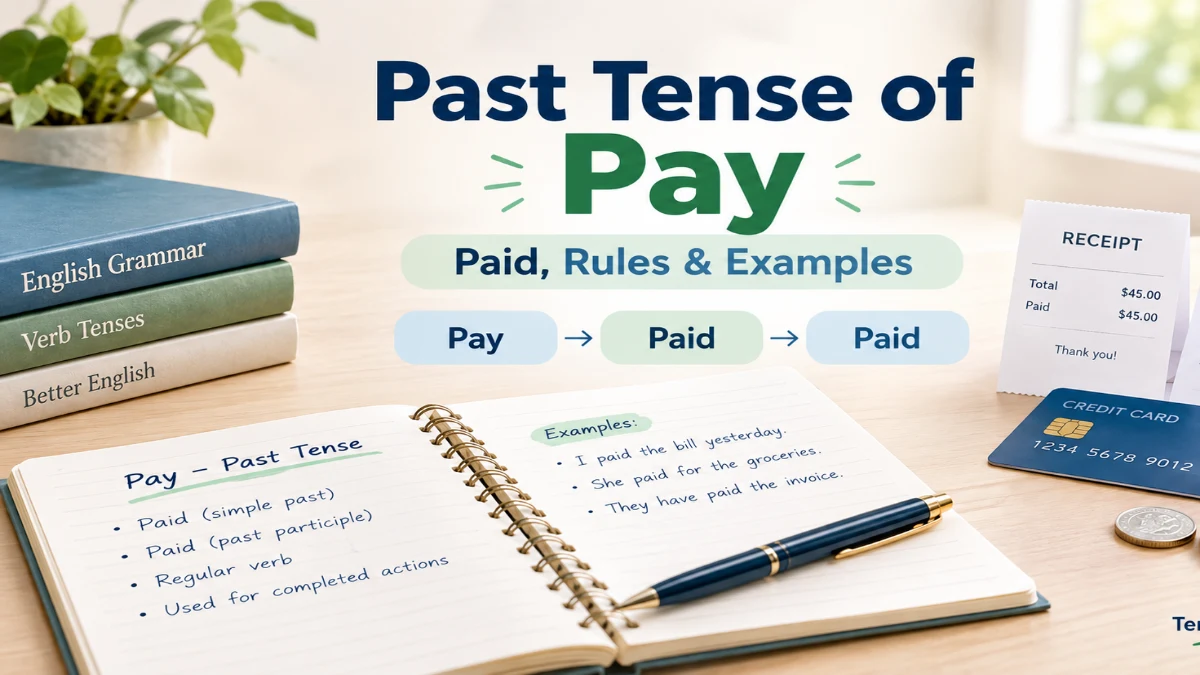
Have you ever written a sentence like “I payed the bill yesterday” and wondered if payed is correct? This is a common mistake because many English verbs form their past tense by adding ed. However, pay does not follow that pattern.
The correct past tense of pay is paid.
For example:
- I pay my bill every month.
- I paid my bill yesterday.
The verb pay is an irregular verb, so its past form changes from pay to paid instead of becoming payed in normal everyday English. The past participle is also paid, which means the three main forms are pay – paid – paid.
In this guide, you will learn the past tense of pay, how to use paid in affirmative, negative, and question forms, why payed is usually incorrect, and how to use pay naturally in real life sentences. You will also find common mistakes, useful grammar rules, comparisons, exercises, and answers.
Quick Answer
The past tense of pay is paid. The past participle is also paid.
| Base Form | Past Tense | Past Participle |
|---|---|---|
| pay | paid | paid |
Example: I paid the bill yesterday.
The word payed is generally not used as the ordinary past tense of pay. It has a limited use in specialized nautical contexts.
What Is the Past Tense of Pay?
The past tense of pay is paid.
Pay is an irregular verb because it does not form its simple past by simply adding ed. Instead, its spelling changes:
pay → paid
Examples:
- I paid for the meal.
- She paid the rent yesterday.
- We paid the driver.
- They paid their employees on Friday.
The word paid can also be used as the past participle of pay.
For example:
- I have paid the bill.
- She had paid before we arrived.
- The workers were paid on time.
Pay: Three Main Verb Forms
The three principal forms of the verb are:
| Verb Form | Word | Example |
|---|---|---|
| V1 – Base form | pay | I pay the bill. |
| V2 – Past tense | paid | I paid the bill. |
| V3 – Past participle | paid | I have paid the bill. |
So, if you are asking “What is the past tense of pay?”, the simple answer is:
Pay → Paid
Structure of Sentences of the Past Tense of Pay
When paid is used as the simple past verb, sentence structure is straightforward.
Affirmative sentences
Use:
Subject + paid + object/complement
Examples:
- I paid the bill.
- She paid the rent.
- He paid for lunch.
- We paid the full amount.
Negative sentences
For negative sentences in the simple past, use did not (didn’t) + pay.
Use:
Subject + did not + pay + object/complement
Examples:
- I did not pay the bill.
- She didn’t pay the rent.
- They didn’t pay for the meal.
Notice that after didn’t, we use the base form pay, not paid.
Incorrect:
- I didn’t paid the bill.
Correct:
- I didn’t pay the bill.
Interrogative sentences
For questions, use:
Did + subject + pay + object/complement?
Examples:
- Did you pay the bill?
- Did she pay the rent?
- Did they pay for dinner?
Again, use pay, not paid, after did.
Formation of the Past Tense of Pay
The past tense of pay is formed irregularly.
Unlike regular verbs such as walk → walked or work → worked, pay changes its form:
pay → paid
There is no need to add ed to pay to form its normal past tense.
Pay in the three main forms
- V1: pay
- V2: paid
- V3: paid
Examples:
- I pay my bills online.
- I paid my bills yesterday.
- I have paid my bills already.
What happens after did?
When did is used, return the verb to its base form.
- Did you pay?
- I didn’t pay.
- Did she pay the fee?
Do not use:
- Did you paid?
- I didn’t paid.
The helping verb did already shows that the sentence is in the past.
What about the ing form?
The present participle or ing form of pay is paying.
| Form | Example |
|---|---|
| Base | I pay online. |
| Past | I paid online. |
| Past participle | I have paid online. |
| -ing form | I am paying online. |
The spelling changes from pay to paying without changing the pronunciation of the vowel sound in the same way that some other verbs do.
How to Use the Past Tense of Pay
The word paid is used when talking about a payment or another action involving pay that happened in the past.
1. Use paid for completed payments
Use paid when someone completed a payment in the past.
Examples:
- I paid the bill yesterday.
- She paid the school fee last week.
- We paid for the tickets.
- He paid the restaurant in cash.
The action is finished.
2. Use paid with time expressions
Common past time expressions include:
- yesterday
- last night
- last week
- last month
- two days ago
- a few minutes ago
- in 2025
Examples:
- I paid the rent last week.
- They paid the invoice two days ago.
- She paid the fee yesterday.
3. Use paid for something
When talking about the thing someone bought or received, pay for is very common.
Examples:
- I paid for the coffee.
- She paid for the tickets.
- We paid for the hotel room.
- He paid for the repairs.
4. Use paid someone
When you give money to a person for work or a service, you can use pay + person.
Examples:
- I paid the driver.
- She paid the mechanic.
- We paid the workers.
- The company paid its employees.
You can also combine both ideas:
- I paid the driver for the trip.
- She paid the mechanic for the repairs.
5. Use paid in passive sentences
The past participle paid can also appear in passive constructions.
Examples:
- The workers were paid on Friday.
- The bill was paid yesterday.
- The employees were paid on time.
Here, paid does not mean that the subject made the payment. Instead, the subject received the payment.
Compare:
- The company paid the workers.
- The workers were paid by the company.
The first sentence is active. The second is passive.
Structure or Verb Pattern Table
Use this table as a quick reference when learning pay, paid, and paid.
| Tense/Form | Structure | Example |
|---|---|---|
| Present simple | subject + pay/pays | I pay the bill. |
| Simple past | subject + paid | I paid the bill. |
| Past negative | subject + didn’t + pay | I didn’t pay the bill. |
| Past question | Did + subject + pay? | Did you pay the bill? |
| Present perfect | have/has + paid | I have paid the bill. |
| Past perfect | had + paid | I had paid the bill. |
| Present continuous | am/is/are + paying | I am paying the bill. |
| Passive past | was/were + paid | The bill was paid. |
The most important pattern to remember is:
pay → paid → paid
Real Life Examples
Here are practical examples showing how paid is used in everyday English.
Everyday payments
- I paid for my coffee this morning.
- She paid the electricity bill yesterday.
- We paid the restaurant before leaving.
- He paid for the groceries.
- They paid the full price.
Work and salary
- The company paid me on Friday.
- The workers were paid at the end of the month.
- She paid her employees on time.
- He was paid for the extra hours he worked.
Shopping
- I paid $50 for the shirt.
- She paid for the shoes with her card.
- We paid cash for the furniture.
- They paid too much for the old car.
Questions
- Did you pay the bill?
- Did she pay for the tickets?
- When did they pay the fee?
- Who paid for dinner?
Negative sentences
- I didn’t pay the fee yesterday.
- She didn’t pay for the meal.
- We didn’t pay the full amount.
- They didn’t pay the invoice on time.
Formal examples
- The customer paid the invoice in full.
- The company paid the outstanding amount.
- The employee was paid for the additional work.
- The organization paid the required fee.
Common Mistakes
Mistake 1: Using “payed” as the normal past tense
Incorrect:
- I payed the bill yesterday.
Correct:
- I paid the bill yesterday.
Why?
Pay is an irregular verb. Its ordinary past tense is paid, not payed.
Mistake 2: Using paid after did
Incorrect:
- Did you paid the bill?
Correct:
- Did you pay the bill?
After did, use the base form of the verb.
Mistake 3: Using paid after didn’t
Incorrect:
- I didn’t paid the rent.
Correct:
- I didn’t pay the rent.
The helping verb didn’t already marks the past tense.
Mistake 4: Confusing pay and paid
Incorrect:
- Yesterday, I pay the bill.
Correct:
- Yesterday, I paid the bill.
When the action happened in the past, use paid.
Mistake 5: Confusing paid and paying
Incorrect:
- I am paid the bill now.
Correct:
- I am paying the bill now.
Use paying with the present continuous:
am/is/are + paying
Mistake 6: Confusing paid and payed
The spelling payed does exist in some specialized uses, particularly in nautical terminology. However, it is not the normal past tense of pay when talking about money.
For ordinary sentences about bills, salaries, prices, or purchases, use paid.
Key Grammar Rules
Rule 1: The past tense of pay is paid
Remember:
pay → paid
Example:
- I paid the bill yesterday.
Rule 2: The past participle is also paid
The V2 and V3 forms are the same:
pay – paid – paid
Example:
- I have paid the bill.
Rule 3: Do not normally use payed for money
For ordinary financial situations, use paid.
- She paid the rent.
- He paid for lunch.
Rule 4: Use pay after did
After did or didn’t, use the base form pay.
- Did you pay?
- I didn’t pay.
Rule 5: Use paid for completed past actions
When the payment happened and finished in the past, use paid.
- We paid the invoice last Friday.
Rule 6: “Pay for” and “pay someone” have different patterns
Use pay for when identifying what the money was used to purchase or cover:
- I paid for the meal.
Use pay + person when identifying who received the money:
- I paid the waiter.
You can also use both:
- I paid the waiter for the meal.
Comparisons with Similar Grammar Forms
Pay vs. Paid
Pay is the base form. Paid is the simple past and past participle.
| Word | Use | Example |
|---|---|---|
| pay | present/base form | I pay every month. |
| paid | past form | I paid yesterday. |
| paid | past participle | I have paid already. |
Paid vs. Paying
Paid refers to a completed payment or can function as a past participle.
Paying is the ing form.
Compare:
- I paid the bill yesterday.
- I am paying the bill now.
The first action is completed. The second action is happening now.
Paid vs. Payed
For normal English about money:
paid = correct
payed = generally incorrect
For example:
- I paid the rent.
- She paid the bill.
- We paid for the tickets.
The specialized word payed can appear in nautical contexts, but this is not the form English learners should use for ordinary financial payments.
Paid vs. Have Paid
Both can refer to payment, but the grammar is different.
Simple past:
- I paid the bill yesterday.
Present perfect:
- I have paid the bill.
Use the simple past when you are talking about a finished past action, especially with a specific past time. The present perfect connects a past action to the present and normally does not use a finished time expression such as yesterday.
Compare:
- I paid the bill yesterday.
- I have paid the bill already.
Exercises
Exercise 1: Fill in the blanks
Complete each sentence with pay, paid, or paying.
- I ________ the bill yesterday.
- She is ________ for the tickets now.
- We usually ________ our rent on the first day of the month.
- He ________ for dinner last night.
- They didn’t ________ the invoice.
- I have already ________ the fee.
Exercise 2: Correct the mistakes
Rewrite each sentence correctly.
- I payed the bill yesterday.
- Did you paid for lunch?
- She didn’t paid the rent.
- We are paid the driver now.
- He payed for the tickets last week.
Exercise 3: Choose the correct answer
1. What is the past tense of pay?
A. Payed
B. Paid
C. Pait
D. Paying
2. Which sentence is correct?
A. I payed the bill.
B. I paid the bill.
C. I paying the bill.
D. I did paid the bill.
3. Which sentence uses “pay” correctly after a helping verb?
A. Did you paid?
B. Did you pay?
C. Did you paying?
D. Did you pays?
4. Which sentence is correct?
A. I didn’t paid the fee.
B. I didn’t pay the fee.
C. I didn’t paying the fee.
D. I wasn’t pay the fee.
Exercise 4: Rewrite the sentences
Change each sentence into the simple past.
- I pay the bill.
- She pays the rent.
- We pay for the tickets.
- They pay the workers.
- He pays the fee.
Exercise 5: Make questions
Turn each statement into a past tense question using Did.
- You paid the bill.
- She paid for dinner.
- They paid the fee.
- He paid the driver.
Answer Key
Exercise 1
- paid
- paying
- pay
- paid
- pay
- paid
Exercise 2
- I paid the bill yesterday.
- Did you pay for lunch?
- She didn’t pay the rent.
- We are paying the driver now.
- He paid for the tickets last week.
Exercise 3
- B. Paid
- B. I paid the bill.
- B. Did you pay?
- B. I didn’t pay the fee.
Exercise 4
- I paid the bill.
- She paid the rent.
- We paid for the tickets.
- They paid the workers.
- He paid the fee.
Exercise 5
- Did you pay the bill?
- Did she pay for dinner?
- Did they pay the fee?
- Did he pay the driver?
FAQs
What is the past tense of pay?
The past tense of pay is paid.
Example:
- I paid the bill yesterday.
Is “payed” the past tense of pay?
For normal English about money, no. The correct past tense is paid.
Pay → paid → paid
The spelling payed has limited specialized uses, including some nautical contexts.
What are the three forms of pay?
The three main forms are:
pay – paid – paid
- V1: pay
- V2: paid
- V3: paid
Is paid a regular or irregular verb form?
Pay is treated as an irregular verb because its past form is paid, rather than the regular payed pattern.
What is the past tense of “pay for”?
The past tense is paid for.
Example:
- I paid for the meal.
What is the past tense of “pay someone”?
It is paid someone.
Example:
- She paid the driver yesterday.
Should I say “Did you paid” or “Did you pay”?
The correct form is “Did you pay?”
After did, use the base form pay.
Should I say “I didn’t pay” or “I didn’t paid”?
The correct sentence is:
I didn’t pay.
Do not use paid after didn’t.
Is “paid” also the past participle?
Yes. Both the simple past and past participle are paid.
- I paid yesterday.
- I have paid already.
What is the ing form of pay?
The ing form is paying.
Example:
- I am paying the bill now.
What is the difference between “paid” and “paying”?
Paid normally describes a completed payment, while paying describes an action in progress.
- I paid the bill.
- I am paying the bill.
Conclusion
The past tense of pay is paid, and the past participle is also paid. The easiest way to remember the three main forms is
Use paid when talking about a completed payment in the past, such as “I paid the bill yesterday.” When making negative sentences or questions with did, return to the base form pay: “I didn’t pay” and “Did you pay?”
One of the most common mistakes is writing payed when talking about money. In ordinary English, paid is the correct form. The word payed has limited specialized uses and should not be used as the normal past tense of pay.
Practice these forms in everyday sentences about bills, shopping, salaries, rent, tickets, and services. Once you remember the pay–paid–paid pattern, using this common irregular verb becomes much easier.
Hi, I’m Robert Lowth, a passionate expert in English tenses and grammar. I specialize in simplifying complex tense rules to help learners understand and use English with confidence. My goal is to make grammar clear, practical, and easy for everyday communication. tenseshub.com