If you are learning Spanish, you may know that llegar means “to arrive” or “to reach.” But when you want to say “I arrived,” “she arrived,” or “they arrived,” the verb changes depending on the past tense you need.
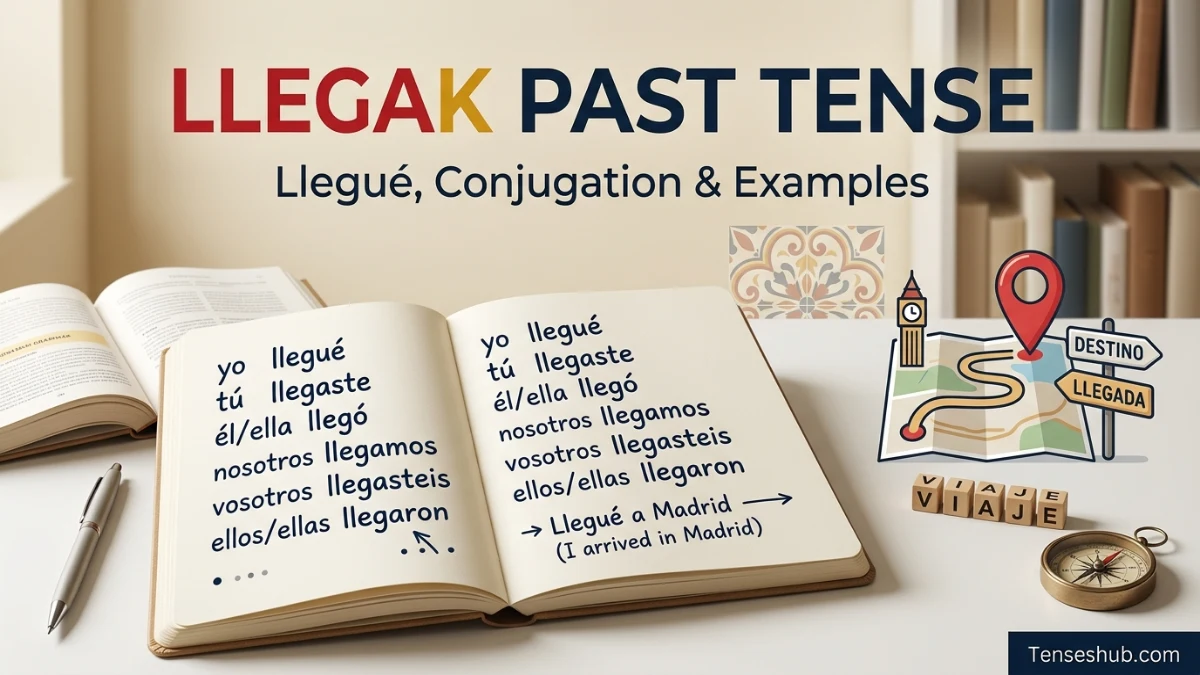
The most common past form of llegar is the preterite, which is used for completed actions in the past. For example, llegué means “I arrived.” You may also see forms such as llegaste, llegó, llegamos, and llegaron.
There is one important spelling change to remember. In the yo form of the preterite, llegar becomes llegué, with gu before the final é. This keeps the hard g sound found in llegar.
Spanish also uses the imperfect tense when an arrival was ongoing, habitual, or part of a background situation. In this guide, you will learn the past tense of llegar, its preterite and imperfect conjugations, formation rules, examples, common mistakes, and useful practice exercises.
Quick Answer
The most common preterite past tense forms of llegar are llegué, llegaste, llegó, llegamos, llegasteis, llegaron.
| Subject | Preterite |
|---|---|
| yo | llegué |
| tú | llegaste |
| él/ella | llegó |
| nosotros | llegamos |
| ellos/ellas | llegaron |
Llegar = to arrive / to reach
Llegué = I arrived
What Is the Past Tense of Llegar?
The Spanish verb llegar means “to arrive,” “to reach,” or “to get to a place.”
When talking about a completed action in the past, Spanish commonly uses the preterite tense, also called the pretérito indefinido or pretérito perfecto simple.
For example:
- Llegué a casa a las ocho. = I arrived home at eight.
- Ella llegó tarde. = She arrived late.
- Llegamos ayer. = We arrived yesterday.
- Ellos llegaron temprano. = They arrived early.
The preterite is especially useful when the arrival happened at a definite point in the past and the action is viewed as completed.
Llegar in the preterite
The full conjugation is:
- yo llegué I arrived
- tú llegaste you arrived
- él/ella/usted llegó he/she/you formal arrived
- nosotros/nosotras llegamos we arrived
- vosotros/vosotras llegasteis you all arrived
- ellos/ellas/ustedes llegaron they/you all arrived
Llegar in the imperfect
Spanish also has an imperfect form of llegar:
- yo llegaba I was arriving / I used to arrive
- tú llegabas
- él/ella/usted llegaba
- nosotros/nosotras llegábamos
- vosotros/vosotras llegabais
- ellos/ellas/ustedes llegaban
The imperfect is used when the arrival was habitual, ongoing, or part of the background of another event.
Structure of Sentences of the Past Tense of Llegar
The basic sentence structure is similar to other Spanish verbs.
Affirmative sentences
For a simple completed past action:
Subject + preterite form of llegar + complement
Examples:
- Yo llegué temprano. = I arrived early.
- María llegó a Madrid. = María arrived in Madrid.
- Nosotros llegamos a las seis. = We arrived at six.
- Ellos llegaron ayer. = They arrived yesterday.
Spanish often leaves out the subject pronoun because the verb ending already shows who performed the action.
So both are possible:
- Yo llegué temprano.
- Llegué temprano.
Both mean “I arrived early.”
Negative sentences
Place no before the conjugated verb.
Subject + no + past tense verb + complement
Examples:
- No llegué tarde. = I did not arrive late.
- Ella no llegó a tiempo. = She did not arrive on time.
- No llegamos ayer. = We did not arrive yesterday.
- Ellos no llegaron temprano. = They did not arrive early.
Interrogative sentences
Questions can use normal Spanish word order or a question structure based on context.
Examples:
- ¿Llegaste ayer? = Did you arrive yesterday?
- ¿Llegó Ana? = Did Ana arrive?
- ¿Llegaron a tiempo? = Did they arrive on time?
- ¿Cuándo llegaste? = When did you arrive?
Spanish does not need a separate equivalent of English did. The past tense form of the verb itself shows that the action happened in the past.
Formation of the Past Tense of Llegar
Llegar is a regular ar verb, but it has an important spelling change in the yo form of the preterite.
Preterite formation
The normal preterite endings for regular ar verbs are:
é, aste, ó, amos, asteis, aron
The verb llegar uses these endings, but its stem changes slightly in the yo form:
lleg + ué → llegué
The u is added before é because Spanish spelling uses gu to keep the hard g sound before e.
Without the u, llegé would not represent the expected pronunciation.
Full preterite conjugation
| Subject | Form |
|---|---|
| yo | llegué |
| tú | llegaste |
| él/ella/usted | llegó |
| nosotros/nosotras | llegamos |
| vosotros/vosotras | llegasteis |
| ellos/ellas/ustedes | llegaron |
Notice that only the yo form has the spelling change:
llegué
The other forms follow the normal regular ar preterite pattern.
Imperfect formation
The imperfect of regular ar verbs uses:
aba, abas, aba, ábamos, abais, aban
Therefore:
- yo llegaba
- tú llegabas
- él llegaba
- nosotros llegábamos
- vosotros llegabais
- ellos llegaban
Unlike the preterite llegué, the imperfect does not have the gu spelling change.
Other forms of llegar
| Form | Example |
|---|---|
| Infinitive | llegar |
| Preterite | llegué |
| Past Participle | llegado |
| Gerund | llegando |
Examples:
- He llegado. = I have arrived.
- Estaba llegando. = I was arriving / I was on my way there.
How to Use the Past Tense of Llegar
The correct past form depends on what you want to say about the action.
1. Use the preterite for a completed arrival
Use the preterite when someone arrived at a specific point in the past.
Examples:
- Llegué a casa a las diez.
= I arrived home at ten. - El tren llegó a las cinco.
= The train arrived at five. - Llegamos a Madrid el lunes.
= We arrived in Madrid on Monday. - Ellos llegaron después de la cena.
= They arrived after dinner.
2. Use the preterite for a single past event
If the arrival happened once and is viewed as completed, the preterite is usually appropriate.
- Ayer llegué temprano.
- I arrived early yesterday.
- Mi hermano llegó a las ocho.
- My brother arrived at eight.
3. Use the imperfect for habitual arrivals
The imperfect can describe something that happened regularly in the past.
- Siempre llegaba temprano a la escuela.
- I always arrived early at school.
- Mi padre llegaba a casa a las seis.
- My father used to arrive home at six.
Here, the action is not presented as one specific completed arrival.
4. Use the imperfect for an ongoing or background action
The imperfect can describe an arrival that was in progress or part of the background when another event happened.
- Cuando llegaba a casa, empezó a llover.
- When I was arriving home, it started to rain.
The arrival provides background, while empezó presents the other event as completed.
5. Use llegar + a + place
When saying that someone arrived at a destination, llegar a is commonly used.
Examples:
- Llegué a París.
- I arrived in Paris.
- Llegamos a la estación.
- We arrived at the station.
- Ella llegó a casa.
- She arrived home.
6. Use llegar + a + infinitive for “manage to”
The construction llegar a + infinitive can have another meaning: to manage to, to come to, or to eventually do something, depending on context.
Example:
- Llegó a entender el problema.
- He eventually came to understand the problem.
This is different from simply saying someone arrived at a place.
Structure or Verb Pattern Table
| Tense/Form | Pattern | Example |
|---|---|---|
| Infinitive | llegar | Quiero llegar temprano. |
| Preterite | llegué / llegaste / llegó | Llegué ayer. |
| Imperfect | llegaba / llegabas / llegaba | Llegaba temprano. |
| Present Perfect | haber + llegado | He llegado. |
| Past Perfect | haber imperfect + llegado | Había llegado. |
| Gerund | llegando | Estoy llegando. |
| Negative Preterite | no + preterite | No llegué tarde. |
The most important forms for learners asking about llegar past tense are:
llegué, llegaste, llegó, llegamos, llegasteis, llegaron
Real Life Examples
Everyday situations
- Llegué a casa tarde anoche.
= I arrived home late last night. - Llegaste justo a tiempo.
= You arrived just in time. - Carlos llegó temprano.
= Carlos arrived early. - Llegamos al aeropuerto a las nueve.
= We arrived at the airport at nine. - Mis amigos llegaron después de mí.
= My friends arrived after me.
With specific past time expressions
- Llegué ayer.
= I arrived yesterday. - Llegó la semana pasada.
= He arrived last week. - Llegamos el sábado.
= We arrived on Saturday. - Llegaron hace dos horas.
= They arrived two hours ago.
Questions
- ¿Cuándo llegaste?
= When did you arrive? - ¿Llegó tu hermana?
= Did your sister arrive? - ¿A qué hora llegaron?
= What time did they arrive? - ¿Llegaste a tiempo?
= Did you arrive on time?
Negative examples
- No llegué tarde.
= I did not arrive late. - Ella no llegó a la reunión.
= She did not arrive at the meeting. - No llegamos a tiempo.
= We did not arrive on time. - Ellos no llegaron ayer.
= They did not arrive yesterday.
Formal examples
- El presidente llegó a la reunión a las diez.
= The president arrived at the meeting at ten. - Los invitados llegaron puntualmente.
= The guests arrived punctually. - La delegación llegó a Madrid el lunes.
= The delegation arrived in Madrid on Monday.
Common Mistakes
Mistake 1: Writing “llegé”
Incorrect:
- Yo llegé ayer.
Correct:
- Yo llegué ayer.
The yo preterite form requires gu before é.
Mistake 2: Forgetting the accent
Incorrect:
- Yo llegue a casa.
Correct:
- Yo llegué a casa.
The accent mark in llegué is important.
Without the accent, llegue can represent a different grammatical form, such as the present subjunctive depending on context.
Mistake 3: Using “llegaste” for él or ella
Incorrect:
- Ella llegaste tarde.
Correct:
- Ella llegó tarde.
Llegaste is the tú form.
Mistake 4: Confusing llegamos with llegábamos
These forms belong to different past tenses.
- Llegamos ayer. = We arrived yesterday.
- Llegábamos temprano todos los días. = We used to arrive early every day.
The first uses the preterite. The second uses the imperfect.
Mistake 5: Adding an English style “did”
English asks:
- Did you arrive?
Spanish simply changes the verb:
- ¿Llegaste?
Do not add an equivalent of did before the verb.
Mistake 6: Confusing llegar with llevar
These verbs look somewhat similar but have different meanings:
- llegar = to arrive
- llevar = to carry / to take / to have been doing something for a period
For example:
- Llegué a casa. = I arrived home.
- Llevé el libro a casa. = I took the book home.
Key Grammar Rules
Rule 1: The preterite of llegar is regular except for the yo spelling change
The forms are:
llegué, llegaste, llegó, llegamos, llegasteis, llegaron
Rule 2: The yo form uses “gu”
Always remember:
llegar → llegué
The u keeps the hard g sound before e.
Rule 3: Keep the accent in llegué
Write:
llegué
not:
llegue
The accent is part of the correct preterite form.
Rule 4: Use the preterite for completed past arrivals
Example:
- Llegué a las ocho.
- I arrived at eight.
Rule 5: Use the imperfect for repeated or ongoing past situations
Example:
- Llegaba temprano todos los días.
- I used to arrive early every day.
Rule 6: Llegar commonly takes “a” before a destination
Examples:
- llegar a Madrid
- llegar a casa
- llegar a la estación
Comparisons with Similar Grammar Forms
Llegué vs. llegaba
The biggest distinction for learners is between the preterite llegué and imperfect llegaba.
Llegué presents the arrival as a completed event:
- Llegué a las ocho.
- I arrived at eight.
Llegaba presents the action as habitual, ongoing, or background information:
- Llegaba a las ocho todos los días.
- I used to arrive at eight every day.
Llegó vs. llegaba
Compare:
- Ana llegó a las nueve.
- Ana arrived at nine.
This describes a specific completed arrival.
- Ana llegaba a las nueve todos los días.
- Ana used to arrive at nine every day.
This describes a repeated past routine.
Llegué vs. he llegado
These are also different.
Llegué is the preterite:
- Llegué ayer.
- I arrived yesterday.
He llegado is the present perfect:
- He llegado.
- I have arrived.
The present perfect connects the past action more directly with the present and is used differently across Spanish speaking regions.
Llegar vs. venir
These verbs are sometimes confused.
- llegar = to arrive
- venir = to come
Examples:
- Llegué a casa a las ocho.
= I arrived home at eight. - Vine a casa a las ocho.
= I came home at eight.
The choice depends on the perspective and meaning of the sentence.
Exercises
Exercise 1: Fill in the blanks
Complete each sentence with the correct preterite form of llegar.
- Yo ________ temprano.
- Tú ________ ayer.
- María ________ a las ocho.
- Nosotros ________ a Madrid el lunes.
- Vosotros ________ tarde.
- Ellos ________ después de la cena.
Exercise 2: Choose the correct form
- Yo ___ a casa a las diez.
A. llegé
B. llegué
C. llegaste
D. llegaba
- Ella ___ temprano ayer.
A. llegaste
B. llegaron
C. llegó
D. llegué
- Nosotros ___ a la estación a las siete.
A. llegamos
B. llegáis
C. llegaron
D. llegábamos
- Ellos ___ la semana pasada.
A. llegó
B. llegaste
C. llegaron
D. llegué
Exercise 3: Correct the mistakes
- Yo llegé tarde.
- Ella llegaste a las nueve.
- Nosotros llegaron ayer.
- ¿Llegasteis a tiempo?
- Yo llegue a Madrid ayer.
Exercise 4: Preterite or imperfect?
Choose the correct form of llegar.
- Ayer yo ________ a casa a las ocho.
(llegué / llegaba) - Todos los días, él ________ temprano.
(llegó / llegaba) - El tren ________ a las seis ayer.
(llegó / llegaba) - Cuando yo ________ a casa, empezó a llover.
(llegué / llegaba) - De niño, siempre ________ tarde a la escuela.
(llegué / llegaba)
Exercise 5: Translate into Spanish
- I arrived yesterday.
- She arrived late.
- We arrived at the airport.
- Did you arrive on time?
- They did not arrive early.
- I used to arrive early every day.
Answer Key
Exercise 1
- llegué
- llegaste
- llegó
- llegamos
- llegasteis
- llegaron
Exercise 2
- B. llegué
- C. llegó
- A. llegamos
- C. llegaron
Exercise 3
- Yo llegué tarde.
- Ella llegó a las nueve.
- Nosotros llegamos ayer.
- ¿Llegasteis a tiempo? This sentence is already correct.
- Yo llegué a Madrid ayer.
Exercise 4
- llegué
- llegaba
- llegó
- llegaba
- llegaba
Exercise 5
- Llegué ayer.
- Ella llegó tarde.
- Llegamos al aeropuerto.
- ¿Llegaste a tiempo?
- No llegaron temprano.
- Llegaba temprano todos los días.
FAQs
What is the past tense of llegar?
The most common simple past form is the preterite. Its forms are llegué, llegaste, llegó, llegamos, llegasteis, llegaron.
What does llegué mean?
Llegué means “I arrived” or, depending on context, “I reached.”
Example:
- Llegué a casa. = I arrived home.
Is llegar regular in the preterite?
Yes. Llegar follows the regular ar preterite endings, but the yo form has a spelling change: llegué.
Why is it llegué and not llegé?
The u is added before é to preserve the hard g sound before the letter e.
What is the yo form of llegar in the past tense?
The preterite yo form is:
llegué
Example:
- Llegué tarde.
- I arrived late.
What is the past participle of llegar?
The past participle is llegado.
Example:
- He llegado a casa.
- I have arrived home.
What is the imperfect tense of llegar?
The imperfect forms are:
llegaba, llegabas, llegaba, llegábamos, llegabais, llegaban
It is used for habitual, repeated, ongoing, or background actions in the past.
What is the difference between llegué and llegaba?
Llegué usually describes a completed past arrival, while llegaba can describe a habitual, ongoing, or background arrival.
How do you say “Did you arrive?” in Spanish?
You can say:
¿Llegaste?
Spanish does not need a separate word corresponding to English did.
Does llegar mean “to arrive” or “to reach”?
It can mean both, depending on context.
- Llegué a Madrid. = I arrived in Madrid.
- Llegué a la meta. = I reached the finish line.
Conclusion
The Spanish past tense of llegar is easy to learn once you understand the difference between the preterite and imperfect. For a completed past arrival, the preterite forms are llegué, llegaste, llegó, llegamos, llegasteis, and llegaron. The most important spelling point is the yo form: llegué, not llegé.
Use the imperfect forms, such as llegaba and llegábamos, when talking about repeated, habitual, ongoing, or background situations in the past. Remember that llegar commonly uses a before a destination, as in llegué a Madrid or llegamos a la estación.
Practice both tenses with real situations such as arriving home, reaching a station, meeting friends, or getting to work. With regular practice, the forms of llegar will become natural and much easier to remember.