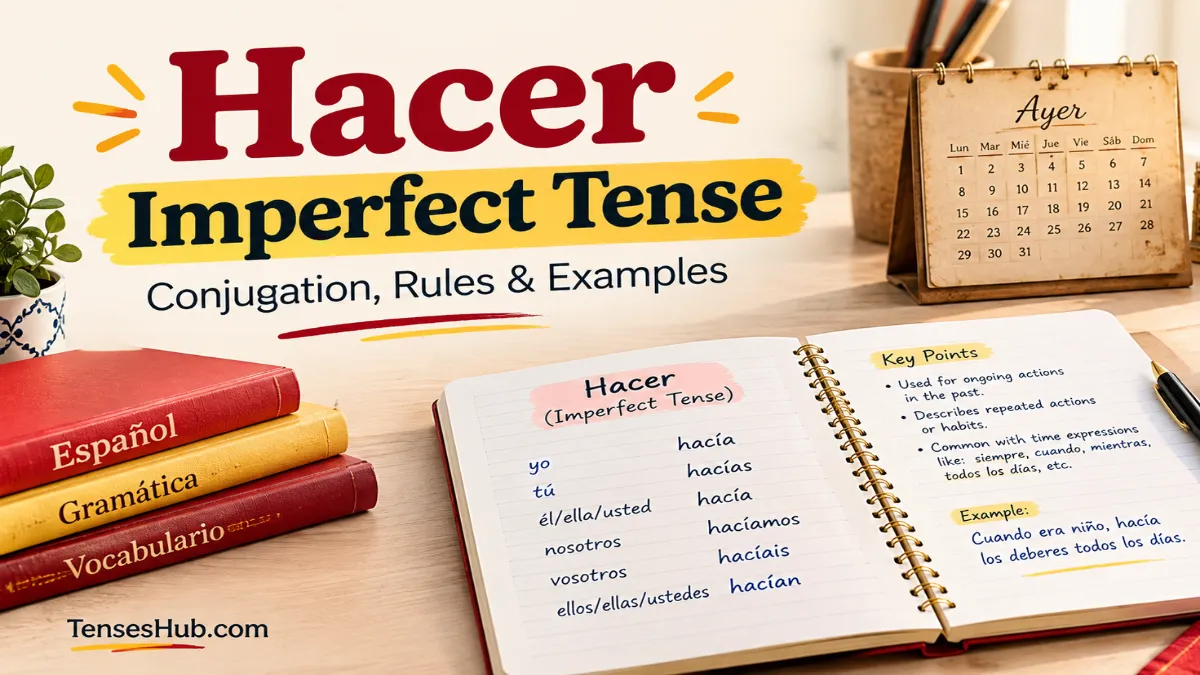
Learning Spanish past tenses can be confusing, especially when one verb appears in several different forms. If you are trying to say “I used to do,” “she was making,” or “we did regularly”, you may wonder which form of hacer you should use.
The Spanish verb hacer means “to do” or “to make.” In the imperfect tense, it is used to talk about actions that happened regularly in the past, descriptions of past situations, ongoing actions, and things that were happening without focusing on when they ended.
For example:
- Yo hacía ejercicio todos los días. = I used to exercise every day.
- Ella hacía la cena cuando llegué. = She was making dinner when I arrived.
- Hacíamos muchas actividades en verano. = We used to do many activities in summer.
The imperfect forms of hacer are irregular, so they need to be learned as a special pattern. In this guide, you will learn every hacer imperfect conjugation, when to use it, how it differs from the preterite, common mistakes, and practical examples.
Quick Answer
The hacer imperfect tense is used to talk about past actions that were habitual, repeated, ongoing, or not viewed as completed. Its imperfect stem is hac , followed by the regular imperfect endings for er/ ir verbs.
| Subject | Hacer imperfect |
|---|---|
| yo | hacía |
| tú | hacías |
| él/ella/usted | hacía |
| nosotros | hacíamos |
| vosotros | hacíais |
| ellos/ustedes | hacían |
For example, yo hacía can mean “I used to do,” “I was doing,” or “I did” depending on the context.
What Is the Hacer Imperfect Tense?
The hacer imperfect tense is the Spanish imperfecto form of the verb hacer.
Hacer is an important Spanish verb that usually means:
- to do
- to make
It can also appear in many common expressions.
Examples:
- hacer la tarea = to do homework
- hacer comida = to make food
- hacer ejercicio = to exercise
- hacer frío = to be cold
- hacer calor = to be hot
- hacer una pregunta = to ask a question
When hacer is placed in the imperfect tense, it describes past situations without presenting the action as a completed event.
Hacer imperfect conjugation
The complete conjugation is:
- yo hacía = I was doing / I used to do
- tú hacías = you were doing / you used to do
- él hacía = he was doing / he used to do
- ella hacía = she was doing / she used to do
- usted hacía = you were doing / you used to do
- nosotros hacíamos = we were doing / we used to do
- vosotros hacíais = you all were doing / you all used to do
- ellos hacían = they were doing / they used to do
- ustedes hacían = you all were doing / you all used to do
Notice that hacía is used for several subjects. The pronoun or context tells you who is performing the action.
Examples
- Yo hacía mi tarea después de cenar.
I used to do my homework after dinner. - Mi madre hacía pan los domingos.
My mother used to make bread on Sundays. - Nosotros hacíamos ejercicio juntos.
We used to exercise together.
Structure of Sentences of Hacer Imperfect Tense
The sentence structure for hacer in the imperfect is straightforward because the conjugated form of hacer normally acts as the main verb.
Affirmative sentences
Basic pattern:
Subject + imperfect form of hacer + complement
Examples:
- Yo hacía la comida.
I was making the food. - Ella hacía su trabajo.
She used to do her work. - Nosotros hacíamos ejercicio.
We used to exercise.
The subject can often be omitted because the verb ending already gives information about the subject.
For example:
- Hacía la comida. = I was making the food.
The context can make it clear that hacía means “I was making” rather than “they was making.”
Negative sentences
Basic pattern:
Subject + no + imperfect form of hacer + complement
Examples:
- Yo no hacía ejercicio.
I did not use to exercise. - Ella no hacía la comida.
She was not making the food. - Nosotros no hacíamos mucho.
We did not do much.
In Spanish, no comes directly before the conjugated verb.
Interrogative sentences
Basic pattern:
¿Imperfect form of hacer + subject + complement?
Examples:
- ¿Qué hacías ayer?
What were you doing yesterday? - ¿Hacías ejercicio todos los días?
Did you use to exercise every day? - ¿Qué hacía él allí?
What was he doing there?
Spanish does not need an auxiliary verb like English did to form these questions.
Formation of Hacer Imperfect Tense
The imperfect of hacer is formed with the irregular stem hac and the regular imperfect endings used with er and ir verbs.
The important point is that hacer does not keep the full infinitive hacer.
Instead:
hacer → hac
Then add the imperfect endings.
Hacer imperfect endings
For er and ir verbs, the imperfect endings are:
ía, ías, ía, íamos, íais, ían
So:
hac + ía = hacía
hac + ías = hacías
hac + ía = hacía
hac + íamos = hacíamos
hac + íais = hacíais
hac + ían = hacían
Why does hacer become hacía?
The infinitive hacer ends in er, but Spanish imperfect conjugation removes er and uses the stem hac .
This gives:
- hacer → hac → hacía
- hacer → hac → hacías
- hacer → hac → hacíamos
The í in these forms carries an accent mark. This accent should not be left out.
Correct:
- hacía
- hacías
- hacíamos
- hacíais
- hacían
Incorrect:
- hacia
- hacias
- haciamos
Without the accent, hacia can be a different Spanish word, meaning “toward.”
How to Use Hacer Imperfect Tense
The imperfect of hacer is mainly used when the speaker wants to describe the background, habit, repetition, or ongoing nature of an action in the past.
1. Repeated past actions
Use hacer imperfect for something that happened repeatedly.
- Yo hacía ejercicio todos los días.
I used to exercise every day. - Ella hacía la tarea después de la escuela.
She used to do her homework after school. - Hacíamos una caminata cada domingo.
We used to take a walk every Sunday.
Words such as siempre, cada día, todos los domingos, and a menudo often help show this meaning.
2. Past habits
The imperfect is useful for describing habits that were normal in the past.
- De niño, hacía muchas preguntas.
As a child, I used to ask many questions. - Mi padre hacía café todas las mañanas.
My father used to make coffee every morning. - Mis amigos y yo hacíamos deporte después de clase.
My friends and I used to play sports after class.
3. Ongoing actions in the past
The imperfect can describe an action that was in progress.
- Yo hacía la cena cuando llamaste.
I was making dinner when you called. - Ella hacía su tarea cuando llegué.
She was doing her homework when I arrived.
Here, hacía gives the background action, while llamaste and llegué are completed past events in the preterite.
4. Background information
The imperfect can establish what was happening around a particular past event.
- Hacía frío cuando salimos.
It was cold when we left. - Hacía mucho ruido mientras estudiábamos.
There was a lot of noise while we were studying.
5. Describing weather and conditions
One especially common use is hacer with weather expressions.
Examples:
- Hacía frío.
It was cold. - Hacía calor.
It was hot. - Hacía mucho viento.
It was very windy. - Hacía buen tiempo.
The weather was good.
These describe a past condition rather than a single completed action.
6. Talking about age
Spanish commonly uses tener to express age, not hacer.
So you should say:
- Cuando tenía diez años…
- When I was ten years old…
Not:
- Cuando hacía diez años…
However, hacer can be used in another important time expression:
- Hacía tres años que vivía allí.
- I had been living there for three years.
This structure can be confusing for beginners because hacía is not expressing age here. It helps express how long something had been happening.
Structure or Verb Pattern Table
Here is a compact reference table for hacer in the imperfect tense.
| Subject | Form | English Meaning |
|---|---|---|
| yo | hacía | I used to do / was doing |
| tú | hacías | you used to do / were doing |
| él/ella/usted | hacía | they/you used to do |
| nosotros | hacíamos | we used to do / were doing |
| vosotros | hacíais | you all used to do |
| ellos/ustedes | hacían | they/you all used to do |
Quick pattern
hacer → hac + imperfect ending
| Subject | Form | English Meaning |
|---|---|---|
| yo | hacía | I used to do / was doing |
| tú | hacías | you used to do / were doing |
| él/ella/usted | hacía | they/you used to do |
| nosotros | hacíamos | we used to do / were doing |
| vosotros | hacíais | you all used to do |
| ellos/ustedes | hacían | they/you all used to do |
Real Life Examples
The best way to understand hacer in the imperfect is to see it in situations that sound natural in everyday Spanish.
Daily routines
- Hacía mi tarea después de cenar.
I used to do my homework after dinner. - Mi hermana hacía ejercicio por la mañana.
My sister used to exercise in the morning. - Hacíamos la limpieza los sábados.
We used to clean on Saturdays.
Childhood memories
- Cuando era niño, hacía muchas preguntas.
When I was a child, I used to ask many questions. - De pequeña, hacía dibujos todos los días.
When she was little, she used to draw every day.
Actions in progress
- Yo hacía la cena cuando llegó mi hermano.
I was making dinner when my brother arrived. - Nosotros hacíamos un proyecto cuando empezó la clase.
We were working on a project when the class started.
Weather
- Hacía mucho frío esa mañana.
It was very cold that morning. - Hacía calor cuando salimos.
It was hot when we went outside.
Questions
- ¿Qué hacías anoche?
What were you doing last night? - ¿Qué hacías después de la escuela?
What did you used to do after school? - ¿Hacías ejercicio regularmente?
Did you exercise regularly?
Negative examples
- No hacía mucho ejercicio.
I did not use to exercise much. - Ella no hacía la comida los viernes.
She did not make the food on Fridays. - No hacíamos nada especial.
We were not doing anything special.
Common Mistakes
Mistake 1: Using the preterite instead of the imperfect for habits
Incorrect for a repeated past habit:
- Todos los días hice ejercicio.
Better when you mean “I used to exercise every day”:
- Todos los días hacía ejercicio.
The imperfect emphasizes the repeated habit.
Mistake 2: Forgetting the accent mark
Incorrect:
- Yo hacia ejercicio.
Correct:
- Yo hacía ejercicio.
The accent is important because hacía is the imperfect form.
Mistake 3: Using the infinitive
Incorrect:
- Yo hacer la tarea todos los días.
Correct:
- Yo hacía la tarea todos los días.
The verb must be conjugated.
Mistake 4: Adding an English style helping verb
English uses “was doing” or “used to do,” but Spanish does not simply copy this structure.
Incorrect:
- Yo estaba hacía la tarea.
Correct:
- Yo hacía la tarea.
If you specifically want to emphasize an action in progress, Spanish can use estar + gerund, but that is a different construction:
- Yo estaba haciendo la tarea.
- I was doing my homework.
Mistake 5: Confusing hacía with hacía falta
The word hacía is the imperfect form of hacer, but expressions such as hacía falta have their own meaning.
- Hacía falta más tiempo.
- More time was needed.
Do not translate every use of hacer word for word as “do” or “make.”
Mistake 6: Confusing hacía and hacia
These two words are different:
- hacía = imperfect form of hacer
- hacia = toward
Compare:
- Ella hacía la comida.
- She was making the food.
- Caminaba hacia la escuela.
- I was walking toward the school.
The accent changes the word and its meaning.
Key Grammar Rules
Rule 1: Use the stem hac
The imperfect forms of hacer use:
hac + imperfect ending
Example:
- hac + ía = hacía
Rule 2: Learn all six forms
The six main forms are:
hacía, hacías, hacía, hacíamos, hacíais, hacían
Memorizing this group makes the verb much easier to recognize.
Rule 3: Do not forget the accent
Most imperfect forms of hacer contain í:
- hacía
- hacías
- hacíamos
- hacíais
- hacían
Rule 4: Use imperfect for repeated or habitual past actions
Example:
- Hacía ejercicio todos los días.
- I used to exercise every day.
Rule 5: Use imperfect for background or ongoing past actions
Example:
- Hacía la cena cuando llegaste.
- I was making dinner when you arrived.
Rule 6: Hacer can describe past weather conditions
Examples:
- Hacía frío. = It was cold.
- Hacía calor. = It was hot.
Rule 7: Context determines the best English translation
Hacía can be translated in different ways:
- I used to do
- I was doing
- I did regularly
- they used to do
- they was doing
The Spanish form stays the same; the English translation changes according to the context.
Comparisons with Similar Grammar Forms
Hacer imperfect vs. hacer preterite
The most important comparison is between the imperfect and preterite.
The imperfect usually presents an action as habitual, repeated, ongoing, or part of the background.
The preterite presents a past action as completed or as a specific event.
Compare:
- Hacía ejercicio todos los días.
= I used to exercise every day. - Hice ejercicio ayer.
= I exercised yesterday.
The first describes a habit. The second refers to a specific completed event.
Hacer imperfect vs. estaba haciendo
These forms can both describe something happening in the past, but they are not exactly the same.
Hacía:
- Hacía la tarea cuando llamaste.
- I was doing my homework when you called.
Estaba haciendo:
- Estaba haciendo la tarea cuando llamaste.
- I was doing my homework when you called.
Both can describe an action in progress. Estaba haciendo more directly highlights the action as being in progress at that particular moment.
Hacer imperfect vs. hacer present
Present tense:
- Hago ejercicio todos los días.
- I exercise every day.
Imperfect:
- Hacía ejercicio todos los días.
- I used to exercise every day.
The present describes a current habit, while the imperfect places the habit in the past.
Hacer imperfect vs. hacer future
Imperfect:
- Hacía la comida.
- I was making the food / I used to make the food.
Future:
- Haré la comida.
- I will make the food.
Notice that the future of hacer is irregular: haré, not haceré.
Exercises
Exercise 1: Fill in the blanks
Complete each sentence with the correct imperfect form of hacer.
- Yo ________ ejercicio todos los días.
- Tú ________ la tarea después de la escuela.
- Ella ________ la cena por la noche.
- Nosotros ________ muchas actividades en verano.
- Vosotros ________ preguntas durante la clase.
- Ellos ________ mucho ruido.
Exercise 2: Choose the correct form
- Cuando era niño, yo ___ muchas preguntas.
- A. hice
- B. hacía
- C. haré
- Nosotros ___ ejercicio cada mañana.
- A. hacíamos
- B. hicimos
- C. haremos
- Ella ___ la cena cuando llegué.
- A. hará
- B. hizo
- C. hacía
- ___ mucho frío en invierno.
- A. Hacía
- B. Hice
- C. Haré
Exercise 3: Correct the mistakes
Correct each sentence.
- Yo hacia ejercicio todos los días.
- Ella hacer la comida por la noche.
- Nosotros hacíamos la tarea ayer a las ocho.
- Yo estaba hacía la cena.
- Cuando era pequeño, hice preguntas constantemente.
Exercise 4: Translate into Spanish
- I used to exercise every morning.
- She was making dinner when I arrived.
- We used to do our homework together.
- It was cold that morning.
- What were you doing?
Exercise 5: Imperfect or preterite?
Choose the form that best fits the meaning.
- Todos los domingos, yo ________ ejercicio.
(hacía / hice) - Ayer yo ________ la tarea a las ocho.
(hacía / hice) - Cuando llegaste, ella ________ la cena.
(hacía / hizo) - El año pasado, nosotros ________ muchas actividades cada semana.
(hacíamos / hicimos)
Answer Key
Exercise 1
- hacía
- hacías
- hacía
- hacíamos
- hacíais
- hacían
Exercise 2
- B. hacía
- A. hacíamos
- C. hacía
- A. Hacía
Exercise 3
- Yo hacía ejercicio todos los días.
The imperfect form needs the accent. - Ella hacía la comida por la noche.
The verb must be conjugated. - Nosotros hacíamos la tarea ayer a las ocho.
This can be correct if the sentence means the action was in progress at eight. If you mean a completed event, hicimos may be more appropriate. - Yo estaba haciendo la cena.
After estaba, use the gerund haciendo, not hacía. - Cuando era pequeño, hacía preguntas constantemente.
The repeated action calls for the imperfect.
Exercise 4
- Hacía ejercicio todas las mañanas.
- Ella hacía la cena cuando llegué.
- Hacíamos la tarea juntos.
- Hacía frío esa mañana.
- ¿Qué hacías?
Exercise 5
- hacía: Repeated habit
- hice: Specific completed event
- hacía: Ongoing background action
- hacíamos: Repeated activity
FAQs
What is the imperfect tense of hacer?
The imperfect forms of hacer are hacía, hacías, hacía, hacíamos, hacíais, and hacían.
What does hacía mean in Spanish?
Hacía can mean “I used to do,” “I was doing,” “he used to do,” or “she was doing,” depending on the context.
Is hacer irregular in the imperfect?
Yes. Hacer uses the stem hac , but its imperfect endings follow the regular er/ ir imperfect pattern.
What is yo hacer in the imperfect?
The correct form is yo hacía.
Example:
- Yo hacía ejercicio.
- I used to exercise.
What is tú hacer in the imperfect?
The correct form is tú hacías.
Example:
- Tú hacías la tarea.
- You used to do your homework.
What is nosotros hacer in the imperfect?
The correct form is nosotros hacíamos.
Example:
- Nosotros hacíamos la comida.
- We used to make the food.
What is the difference between hacía and hice?
Hacía is the imperfect and usually describes a habitual, ongoing, or background action. Hice is the preterite and usually describes a completed past event.
How do you say “I used to do” in Spanish?
You normally say yo hacía.
Example:
- Yo hacía ejercicio todos los días.
- I used to exercise every day.
How do you say “I was doing” in Spanish?
Depending on the context, you can use hacía or estaba haciendo.
- Hacía la tarea cuando llamaste.
- Estaba haciendo la tarea cuando llamaste.
Both can mean “I was doing my homework when you called,” with a slightly different focus.
How do you say “it was cold” using hacer?
Use:
Hacía frío.
This is a common imperfect expression used to describe past weather.
Does hacer have an accent in the imperfect?
Yes. The imperfect forms use an accented í:
hacía, hacías, hacía, hacíamos, hacíais, hacían.
Conclusion
The imperfect tense of hacer is an important Spanish form for talking about past habits, repeated actions, ongoing activities, background situations, and past weather conditions. The key forms to remember are hacía, hacías, hacía, hacíamos, hacíais, and hacían.
The pattern becomes easier once you remember that hacer uses the stem hac with the imperfect endings ía, ías, ía, íamos, íais, and ían. Pay special attention to the accent marks, especially in hacía and hacíamos.
Most importantly, compare the imperfect with the preterite. Use hacía when you are describing a habit, an ongoing action, or background information, and use hice when you want to present a specific completed event.
Practice these forms in everyday sentences, and you will quickly become more comfortable using hacer in the imperfect tense in both conversation and writing.

Hi, I’m Noah Bester, a tenses expert passionate about simplifying English grammar. I create practical, easy-to-understand guides to help learners master tenses with confidence. My goal is to make grammar clear, useful, and applicable in everyday communication. tenseshub.com