Do you sometimes know what you want to say in English but feel unsure about which verb form to use? For example, should you say “She works,” “She is working,” or “She has worked”? These small differences can be confusing, especially when you are learning English grammar.
Understanding present tense examples makes these choices much easier. The present tense is used to talk about habits, routines, facts, actions happening now, and situations connected to the present. It is one of the most important grammar topics for everyday English.
In this guide, you will learn the four main present tenses with simple examples. You will also see sentence structures, common mistakes, practical rules, comparisons, exercises, and real life sentences.
if you are a student, writer, blogger, freelancer, or English learner, these examples can help you use the present tense more naturally and confidently.
Quick Answer
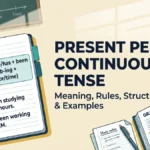
Present tense is used to talk about actions, habits, facts, situations, and events connected to the present. English has four main present tenses: simple present, present continuous, present perfect, and present perfect continuous.
| Present Tense | Example |
|---|---|
| Simple Present | I buy books every month. |
| Present Continuous | I am buying a book now. |
| Present Perfect | I have bought a new book. |
| Present Perfect Continuous | I have been buying books for years. |
What Is Present Tense Examples?
The phrase present tense examples refers to sentences that show how present tense forms are used in English.
The present tense generally describes something that happens regularly, is happening now, is true in the present, or started in the past and has a connection with the present.
English has four main present tense forms:
- Simple Present Tense I work every day.
- Present Continuous Tense I am working now.
- Present Perfect Tense I have finished my work.
- Present Perfect Continuous Tense I have been working for two hours.
Each form has a different purpose.
For example:
- She reads books. → regular habit
- She is reading a book. → happening now
- She has read the book. → completed action with present relevance
- She has been reading for an hour. → action continuing over a period of time
Learning these differences helps you choose the correct tense instead of using the same verb pattern for every situation.
Structure of Sentences of Present Tense Examples
The four present tenses use different sentence patterns. The basic word order becomes easier when you separate affirmative, negative, and interrogative sentences.
Simple Present
Affirmative:
Subject + V1/V1+s/es + object
She plays tennis.
Negative:
Subject + do/does not + V1 + object
She does not play tennis.
Interrogative:
Do/Does + subject + V1 + object?
Does she play tennis?
Present Continuous
Affirmative:
Subject + am/is/are + V ing
They are watching TV.
Negative:
Subject + am/is/are + not + V ing
They are not watching TV.
Interrogative:
Am/Is/Are + subject + V ing?
Are they watching TV?
Present Perfect
Affirmative:
Subject + has/have + V3
He has finished his homework.
Negative:
Subject + has/have + not + V3
He has not finished his homework.
Interrogative:
Has/Have + subject + V3?
Has he finished his homework?
Present Perfect Continuous
Affirmative:
Subject + has/have + been + V ing
She has been studying for three hours.
Negative:
Subject + has/have + not + been + V ing
She has not been studying for three hours.
Interrogative:
Has/Have + subject + been + V ing?
Has she been studying for three hours?
Formation of Present Tense Examples
The four present tenses are formed with different helping verbs and main verb forms.
1. Simple Present
The simple present normally uses the base verb.
With he, she, and it, the verb usually takes s or es.
- I work.
- You work.
- They work.
- He works.
- She watches.
- It rains.
After do or does, always use the base verb:
She does not work here.
Not:
She does not works here. ❌
2. Present Continuous
Use:
am/is/are + V ing
Examples:
- I am writing.
- He is sleeping.
- They are playing.
Some spelling changes occur when adding ing:
- make → making
- write → writing
- run → running
- sit → sitting
3. Present Perfect
Use:
has/have + past participle (V3)
Examples:
- I have finished.
- She has written.
- They have gone.
- He has eaten.
Regular verbs often end in ed, while irregular verbs may change completely.
- work → worked → worked
- play → played → played
- go → went → gone
- write → wrote → written
4. Present Perfect Continuous
Use:
has/have + been + V ing
Examples:
- I have been working.
- She has been reading.
- They have been waiting.
Use has with he, she, and it. Use have with I, you, we, and they.
How to Use Present Tense Examples
The present tense is not limited to actions happening at this exact moment. Different present forms express different meanings.
Simple Present for Habits and Routines
Use the simple present for things that happen regularly.
I drink coffee every morning.
She walks to school.
We visit our grandparents on Sundays.
Common time expressions include:
- every day
- usually
- often
- sometimes
- always
- never
- every week
Simple Present for Facts
Use it for general facts and things that are normally true.
The Earth moves around the Sun.
Water boils at 100°C.
Birds have feathers.
Present Continuous for Actions Happening Now
Use the present continuous for an action happening around the time of speaking.
I am writing an email.
The children are playing outside.
She is talking to her friend.
Words such as now, right now, at the moment, and currently are often used with this tense.
Present Continuous for Temporary Situations
It can also describe something happening for a limited period.
I am staying with my uncle this week.
She is working from home this month.
The situation may not be happening permanently.
Present Perfect for Completed Actions Connected to the Present
The present perfect often connects a past action with the present.
I have lost my keys.
The important point is that the keys are still missing now.
Another example:
She has finished her homework.
The homework is complete, and that result matters now.
Present Perfect for Life Experiences
I have visited Lahore.
He has never eaten sushi.
Have you ever ridden a horse?
The exact past time is not the main focus.
Present Perfect Continuous for Duration
Use this tense when you want to emphasize how long an activity has continued.
I have been studying for two hours.
She has been working here since January.
For usually introduces a period:
for two hours
Since usually introduces a starting point:
since Monday
Present Tense Structure or Verb Pattern Table
| Tense | Basic Pattern | Example |
|---|---|---|
| Simple Present | Subject + V1/V1+s/es | She buys books. |
| Present Continuous | Subject + am/is/are + V-ing | She is buying a book. |
| Present Perfect | Subject + has/have + V3 | She has bought a book. |
| Present Perfect Continuous | Subject + has/have + been + V-ing | She has been buying books. |
Real Life Present Tense Examples
Here are practical examples from everyday English.
Simple Present Examples
- I wake up at seven every morning.
- She teaches English.
- My brother plays football.
- We live in Islamabad.
- They usually eat dinner at eight.
- The shop opens at nine.
- He does not drink coffee.
- Do you work on weekends?
Present Continuous Examples
- I am doing my homework.
- She is cooking dinner.
- They are watching a movie.
- We are waiting for the bus.
- He is talking on the phone.
- The baby is sleeping.
- I am not watching television.
- Are you listening to me?
Present Perfect Examples
- I have finished my assignment.
- She has cleaned her room.
- We have visited this museum before.
- He has lost his wallet.
- They have already eaten.
- Have you completed the project?
- I have not seen that movie.
- She has never traveled abroad.
Present Perfect Continuous Examples
- I have been studying since morning.
- She has been working all day.
- They have been waiting for an hour.
- He has been learning English for three years.
- We have been talking about this problem.
- Have you been waiting long?
Formal Examples
The company provides online training.
The research team is currently examining the results.
We have completed the required documents.
Informal Examples
I usually hang out with my friends on Friday.
I’m watching a movie right now.
I’ve already finished it.
Common Mistakes
Mistake 1: Adding s After Does
❌ She does not likes tea.
✅ She does not like tea.
After does, use the base verb.
Mistake 2: Using V ing Without a Helping Verb
❌ They playing football.
✅ They are playing football.
The present continuous needs am, is, or are.
Mistake 3: Using the Wrong Verb After Has/Have
❌ She has went home.
✅ She has gone home.
The present perfect requires the past participle (V3).
Mistake 4: Confusing Simple Present and Present Continuous
❌ I am going to school every day.
If you mean a regular routine, say:
✅ I go to school every day.
But if the action is happening now:
✅ I am going to school now.
Mistake 5: Confusing Since and For
❌ I have lived here since five years.
✅ I have lived here for five years.
Use for with a period of time and since with a starting point.
Mistake 6: Using Present Perfect With a Finished Past Time
❌ I have visited London last year.
✅ I visited London last year.
A specific finished past time such as last year, yesterday, or in 2020 normally requires the simple past.
Key Grammar Rules
- Use the simple present for habits, routines, and general facts.
She walks to work every day. - Use s or es with he, she, and it in affirmative simple present sentences.
He watches TV. - Use am/is/are + V ing for present continuous actions.
They are studying. - Use has/have + V3 for the present perfect.
She has finished the task. - Use has/have + been + V ing for the present perfect continuous.
I have been waiting for an hour. - Use do/does for simple present questions and negatives.
Does he work here? - Do not use a specific finished past time with the present perfect
I saw him yesterday.
Not: I have seen him yesterday.
Comparisons With Similar Grammar Forms
Simple Present vs Present Continuous
The simple present usually describes a routine or fact, while the present continuous describes an action happening now or around now.
I work at a bank.
→ This is my regular job.
I am working from home today.
→ This is a temporary situation.
Present Perfect vs Simple Past
The present perfect connects a past action to the present and usually does not specify a finished past time.
I have lost my phone.
→ It is still lost.
I lost my phone yesterday.
→ The sentence gives a finished past time.
Present Perfect vs Present Perfect Continuous
The present perfect often focuses on the result or completion.
I have cleaned the room.
The present perfect continuous often focuses on the activity or duration.
I have been cleaning the room for an hour.
Present Tense vs Past Tense
The present tense describes current situations, habits, facts, or actions connected to now.
She works in a hospital.
The simple past describes a completed action in the past.
She worked in a hospital last year.
If you are learning these forms together, related topics such as past tense examples, future tense examples, and the 12 English tenses can help you understand the larger tense system.
Exercises
Exercise 1: Fill in the Blanks
Choose the correct present tense form.
- She ________ to school every day. (walk)
- They ________ dinner right now. (eat)
- I ________ my homework already. (finish)
- He ________ here for three hours. (wait)
- The sun ________ in the east. (rise)
Exercise 2: Correct the Sentences
- She do not like coffee.
- He is play football.
- They has finished the work.
- I have been study English for two years.
- Does she works here?
Exercise 3: Choose the Correct Answer
- My father ___ to work every morning.
a) go
b) goes
c) is go - Listen! The baby ___.
a) cries
b) is crying
c) has cry - I ___ this book before.
a) have read
b) am read
c) has read - She ___ for two hours.
a) has been studying
b) is study
c) have studying - ___ you speak English?
a) Does
b) Are
c) Do
Exercise 4: Rewrite the Sentences
Change each sentence into the form requested.
- She works here. → Make it negative.
- They are watching TV. → Make it a question.
- He has completed the task. → Make it negative.
- You play tennis. → Make it a question.
- She has been waiting for an hour. → Make it negative.
Answer Key
Exercise 1
- walks
- are eating
- have finished
- has been waiting
- rises
Exercise 2
- She does not like coffee.
- He is playing football.
- They have finished the work.
- I have been studying English for two years.
- Does she work here?
Exercise 3
- b) goes
- b) is crying
- a) have read
- a) has been studying
- c) Do
Exercise 4
- She does not work here.
- Are they watching TV?
- He has not completed the task.
- Do you play tennis?
- She has not been waiting for an hour.
FAQs
What are some simple present tense examples?
Examples include:
I go to school every day.
She likes music.
They play football on Sundays.
The simple present is commonly used for habits, routines, and facts.
What are 5 examples of present tense?
- I read books.
- She works at a bank.
- They are playing outside.
- He has finished his homework.
- We have been waiting for an hour.
These examples represent different present tense forms.
What is the present tense of a verb?
The present form is generally the base form of a verb, such as work, play, read, or write. With he, she, and it, the simple present often adds s or es.
I work.
She works.
What are the four types of present tense?
The four main types are:
- Simple Present
- Present Continuous
- Present Perfect
- Present Perfect Continuous
When do we use the simple present tense?
Use it for habits, routines, general facts, and regular situations.
He exercises every morning.
When do we use the present continuous?
Use it for actions happening now or temporary situations.
She is studying now.
What is the difference between “I work” and “I am working”?
I work usually describes a regular activity or situation.
I work in a school.
I am working usually describes an action happening now or around the present.
I am working on a new project.
How do I know which present tense to use?
Think about the meaning first. Ask if you are describing a habit, action happening now, completed action connected to the present, or activity continuing over time. Then choose the appropriate present tense.
Can present tense talk about the future?
Yes. The simple present can describe scheduled events.
The train leaves at 8 p.m.
The present continuous can also describe a planned future arrangement.
I am meeting my friend tomorrow.
Conclusion
Learning present tense examples is one of the best ways to build a strong foundation in English grammar. The four main forms—simple present, present continuous, present perfect, and present perfect continuous—each have a different purpose. The simple present works well for habits and facts, while the present continuous describes actions happening now or temporary situations.
The present perfect connects past actions with the present, and the present perfect continuous emphasizes an activity that has continued over time. Once you understand these differences, choosing the correct tense becomes much easier.
The best way to improve is to practice with real sentences. Describe your daily routine, explain what you are doing now, talk about things you have completed, and describe activities you have been doing for a period of time. Regular practice will help you use present tenses naturally and confidently.