Have you ever seen sentences like “Cuando era niño…” or “La casa era grande” and wondered why Spanish uses era instead of fue? Many learners struggle with the ser in imperfect tense because both forms refer to the past, but they are used in different situations.
The imperfect tense is one of the most important Spanish tenses because it helps you describe people, places, emotions, habits, and ongoing situations in the past. Since ser is an irregular verb, its imperfect forms must be memorized rather than built from regular patterns.
Understanding ser in imperfect tense will help you speak naturally about childhood memories, past descriptions, routines, and background information.
If you are a student, traveler, blogger, or Spanish learner, mastering this tense can make your Spanish sound much more fluent and accurate.
Quick Answer (Featured Snippet)
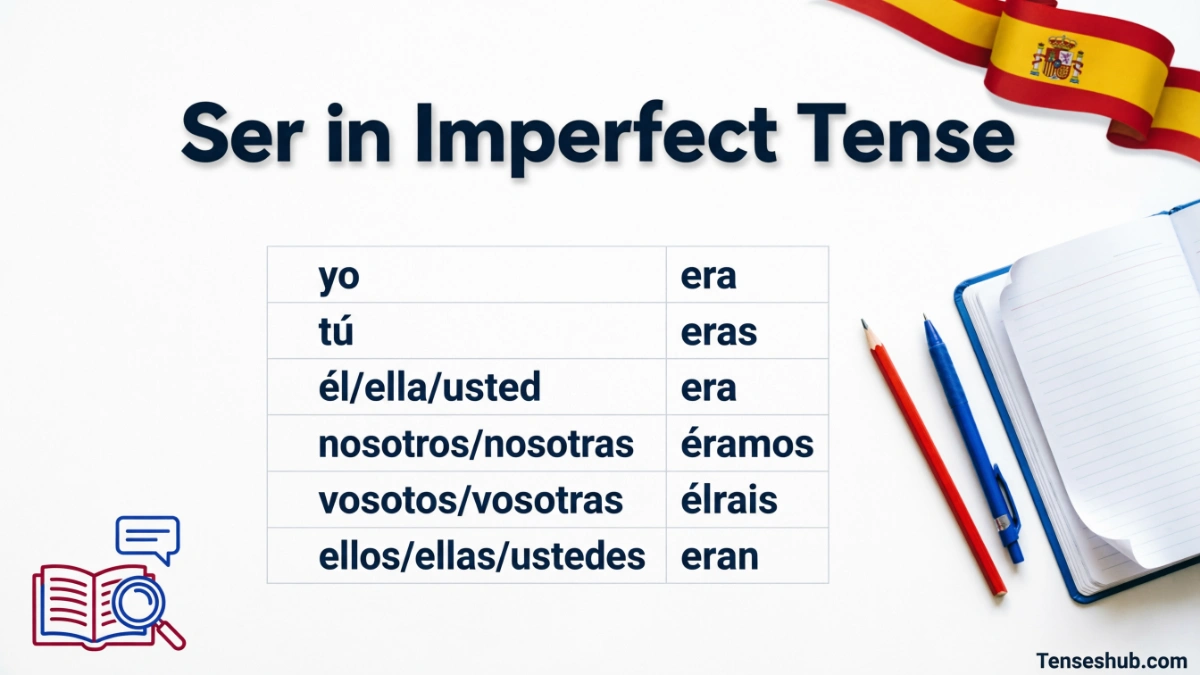
The ser imperfect tense is used to describe what someone or something was like in the past. It often expresses descriptions, characteristics, time, age, occupations, and repeated situations.
| Subject | Imperfect Form |
|---|---|
| Yo | era |
| Tú | eras |
| Él / Ella / Usted | era |
| Nosotros / Nosotras | éramos |
| Vosotros / Vosotras | erais |
| Ellos / Ellas / Ustedes | eran |
What Is Ser in Imperfect Tense?
The verb ser means “to be” in Spanish.
In the imperfect tense, ser is used to describe ongoing or repeated situations in the past rather than completed events.
Examples:
- Yo era estudiante. (I was a student.)
- La ciudad era tranquila. (The city was quiet.)
- Ellos eran muy amables. (They were very kind.)
The imperfect tense often answers questions like:
- What was it like?
- How was someone?
- What used to happen?
- What were things like in the past?
Unlike the preterite tense, which focuses on completed actions, the imperfect focuses on descriptions and background information.
Structure of Sentences of Ser in Imperfect Tense
Affirmative Structure
Subject + imperfect form of ser + complement
Examples:
- Yo era feliz.
- Nosotros éramos vecinos.
- Ellas eran profesoras.
Negative Structure
Subject + no + imperfect form of ser + complement
Examples:
- Yo no era tímido.
- Ella no era médica.
- Ellos no eran ricos.
Interrogative Structure
¿Imperfect form of ser + subject + complement?
Examples:
- ¿Eras estudiante?
- ¿Era grande la casa?
- ¿Eran amigos ustedes?
Formation of Ser in Imperfect Tense
The verb ser is completely irregular in many Spanish tenses, but its imperfect forms are actually simple because there are only a few forms to memorize.
Conjugation of Ser in the Imperfect Tense (Spanish)
| Subject Pronoun | Form |
|---|---|
| Yo | era |
| Tú | eras |
| Él / Ella / Usted | era |
| Nosotros / Nosotras | éramos |
| Vosotros / Vosotras | erais |
| Ellos / Ellas / Ustedes | eran |
Important Note
Unlike regular verbs, ser does not follow standard imperfect endings added to a stem. Therefore, learners should memorize the complete conjugation.
Examples:
- Yo era feliz.
- Tú eras joven.
- Nosotros éramos amigos.
Accent Rule
Notice the accent mark in:
éramos
This accent must be written correctly because it affects pronunciation and spelling.
How to Use Ser in Imperfect Tense
The imperfect form of ser is commonly used in several situations.
1. Describing People in the Past
Use it to describe appearance, personality, or characteristics.
Examples:
- Mi abuelo era alto.
- Ella era inteligente.
- Eran muy simpáticos.
2. Talking About Age
Examples:
- Cuando era niño, jugaba mucho.
- Mi hermana era pequeña.
3. Describing Places
Examples:
- La casa era antigua.
- El barrio era tranquilo.
4. Talking About Time and Dates
Examples:
- Era la una de la tarde.
- Era lunes.
5. Describing Occupations
Examples:
- Mi padre era profesor.
- Ella era médica.
6. Giving Background Information
Examples:
- El día era soleado.
- La fiesta era divertida.
7. Talking About Repeated Situations
Examples:
- Cuando éramos niños, íbamos al parque.
- Los veranos eran muy calurosos.
Structure / Verb Pattern Table
| Sentence Type | Pattern | Example |
|---|---|---|
| Affirmative | Subject + ser (imperfect) + complement | Ella era doctora. |
| Negative | Subject + no + ser (imperfect) + complement | Ella no era doctora. |
| Question | ¿Ser (imperfect) + subject + complement? | ¿Era ella doctora? |
| Description | Subject + era/eran + adjective | El día era frío. |
| Age | Subject + era + age | Yo era joven. |
| Occupation | Subject + era + profession | Mi padre era profesor. |
Real Life Examples
Here are practical examples of ser in imperfect tense.
Affirmative Sentences
- Yo era estudiante de español.
- Mi hermano era muy divertido.
- La escuela era grande.
- Nosotros éramos buenos amigos.
- Ellos eran vecinos.
Negative Sentences
- Yo no era deportista.
- Ella no era alta.
- Nosotros no éramos compañeros.
- Ellos no eran ricos.
Questions
- ¿Eras feliz cuando eras niño?
- ¿Era bonita la ciudad?
- ¿Eran tus profesores estrictos?
Informal Situations
- Mi perro era muy juguetón.
- La comida era excelente.
Formal Situations
- El edificio era histórico.
- El director era responsable de la organización.
Common Mistakes — Ser in the Imperfect Tense
| Wrong | Correct | Why? |
|---|---|---|
| Yo fue estudiante. | Yo era estudiante. | Description needs imperfect (era), not past tense fue. |
| Ella era una vez al médico. | Ella iba al médico. | “Going somewhere” uses ir, not ser. |
| Nosotros eran amigos. | Nosotros éramos amigos. | Incorrect conjugation; nosotros = éramos. |
| Yo era cansé. | Yo estaba cansado. | Temporary states use estar, not ser. |
| Ellos fue amables. | Ellos eran amables. | Past descriptions use imperfect eran. |
Key Grammar Rules
1. Use Ser for Permanent or Defining Characteristics
- Mi abuelo era paciente.
- La casa era enorme.
2. Use Imperfect for Descriptions
- El jardín era hermoso.
- La ciudad era tranquila.
3. Use Ser for Time and Dates
- Era domingo.
- Eran las tres.
4. Use Ser for Occupations
- Mi madre era enfermera.
- Él era abogado.
5. Use Imperfect for Background Information
- El clima era agradable.
- La fiesta era interesante.
6. Memorize the Forms
The forms era, eras, era, éramos, erais, eran must be learned as a complete set.
Comparisons with Similar Grammar Forms
Ser Imperfect vs Ser Preterite
Both refer to the past, but their meanings differ.
| Imperfect | Preterite |
| Describes situations | Describes completed events |
| Ongoing background | Specific occurrence |
| Habitual or repeated | Single completed action |
Examples:
- La ciudad era tranquila. (The city was quiet.)
- La fiesta fue divertida. (The party was fun.)
Ser vs Estar in the Past
Ser describes identity or characteristics.
- Mi abuelo era amable.
Estar describes temporary states.
- Mi abuelo estaba cansado.
Ser Imperfect vs Estar Imperfect
- Ella era feliz. (Her general character or state of life.)
- Ella estaba feliz. (She was happy at that moment.)
This distinction is one of the most important concepts in Spanish grammar.
Exercises
Exercise 1: Fill in the Blanks
Choose the correct imperfect form of ser.
- Yo _____ estudiante.
- Nosotros _____ amigos.
- Tú _____ muy amable.
- Ellos _____ vecinos.
- La casa _____ grande.
Exercise 2: Correct the Mistakes
- Nosotros eran compañeros.
- Yo fue niño.
- Ella eran profesora.
- Tú era alto.
- Ellos fue simpáticos.
Exercise 3: Rewrite the Sentences
Change to negative form.
- Yo era feliz.
- Ella era médica.
- Nosotros éramos vecinos.
Exercise 4: Multiple Choice
1. Which form is correct for “we were”?
A) era
B) eras
C) éramos
D) eran
2. Which sentence is correct?
A) Nosotros eran amigos.
B) Nosotros éramos amigos.
C) Nosotros era amigos.
D) Nosotros fue amigos.
3. Which sentence describes a past characteristic?
A) Ella fue al mercado.
B) Ella era amable.
C) Ella comió pizza.
D) Ella llegó temprano.
Answer Key
Exercise 1
- era
- éramos
- eras
- eran
- era
Exercise 2
- Nosotros éramos compañeros.
- Yo era niño.
- Ella era profesora.
- Tú eras alto.
- Ellos eran simpáticos.
Exercise 3
- Yo no era feliz.
- Ella no era médica.
- Nosotros no éramos vecinos.
Exercise 4
- C
- B
- B
FAQs
What is the imperfect tense of ser?
The imperfect forms are era, eras, era, éramos, erais, eran.
What does ser imperfect mean?
It means was or were when describing characteristics, identities, occupations, age, time, or background situations.
Is ser irregular in the imperfect tense?
Yes. The forms are irregular and should be memorized.
When should I use era instead of fue?
Use era for descriptions or ongoing situations. Use fue for completed events.
What is the difference between era and estaba?
Era describes characteristics or identity, while estaba describes temporary conditions or states.
Is éramos the only form with an accent mark?
Yes. Éramos contains the accent mark in the standard imperfect conjugation of ser.
Conclusion
Learning ser in imperfect tense is an important step toward speaking natural Spanish. This tense helps you describe what people, places, and situations were like in the past. The forms era, eras, era, éramos, erais, and eran are used to talk about age, personality, occupations, time, dates, and background descriptions.
Many learners confuse ser imperfect with the preterite tense or with estar, but remembering the main purpose of the imperfect describing ongoing or repeated past situations makes the choice much easier.
Practice creating sentences about your childhood, old friends, schools, and past experiences using ser. With regular practice, these forms will become automatic, and your Spanish conversations and writing will sound much more fluent and accurate.