Have you ever wondered if the past tense of hang is hung or hanged? You may have seen both words in books, news stories, or everyday conversations. Although both forms are correct, they are not always used in the same way. Choosing the right word depends on what you want to say.
The verb hang is an irregular English verb. We use it to describe placing something so that it is supported from above, such as hanging a picture on a wall, hanging clothes on a line, or hanging a coat on a hook. We also use it when talking about how a person or object is suspended.
The good news is that learning its past forms is simple once you understand the main rule. In most everyday situations, the past tense is hung. The form hanged is mainly used when describing a person being put to death by hanging.
In this guide, you will learn the past tense of hang, its verb forms, sentence patterns, common mistakes, and practical examples to help you use both forms correctly.
Quick Answer: What Is the Past Tense of Hang?
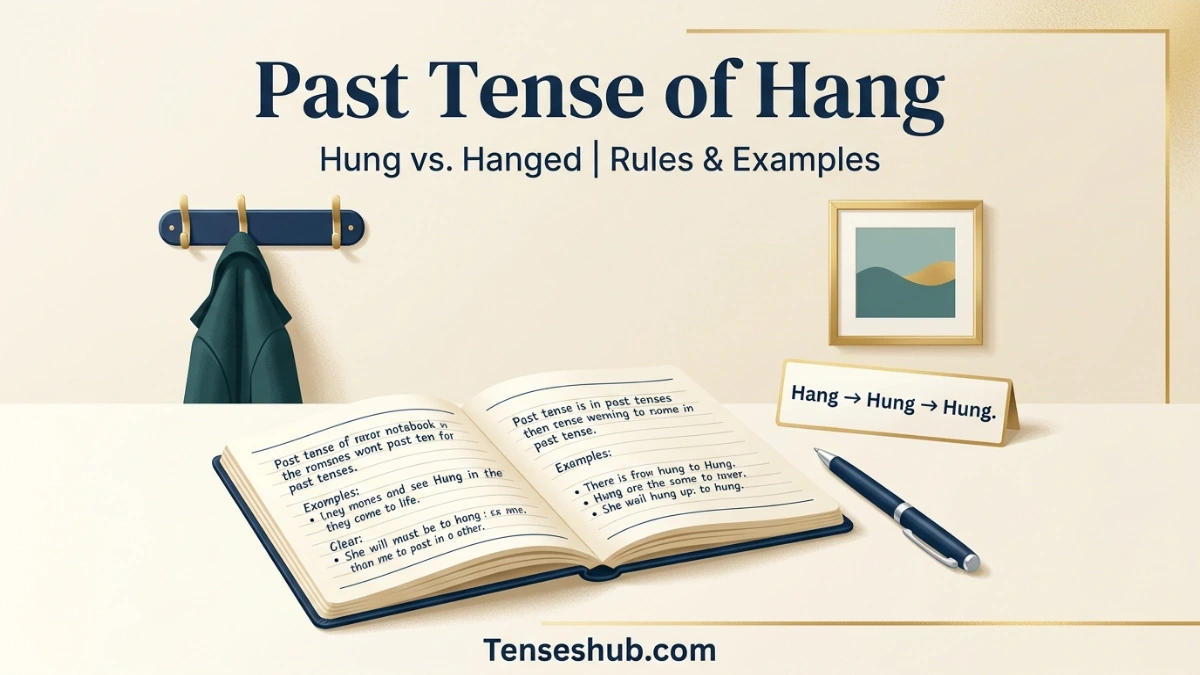
The simple past tense of hang is usually hung. However, hanged is used when referring to execution by hanging.
| Verb Form | Word |
|---|---|
| Base form (V1) | Hang |
| Simple past (V2) | Hung / Hanged |
| Past participle (V3) | Hung / Hanged |
| -ing form | Hanging |
| Third person singular | Hangs |
Examples:
- I hung my jacket on the hook.
- She has hung the picture above her desk.
- The prisoner was hanged for his crimes.
Remember: use hung for ordinary meanings of hanging and hanged when referring to execution.
What Is the Past Tense of Hang?
The past tense of hang describes an action that happened and finished in the past. Because hang is an irregular verb, it does not form its past tense by simply adding ed.
For most meanings, the verb changes from hang to hung:
- Present: I hang my coat by the door.
- Past: I hung my coat by the door yesterday.
- Present perfect: I have hung my coat by the door.
In each sentence, the verb describes placing an object so that it is supported from above.
What Does Hang Mean?
The verb hang has several common meanings:
1. To attach or suspend something
- Please hang the calendar on the wall.
- He hung his backpack behind the door.
2. To put clothes or fabric somewhere
- I hang my clothes outside to dry.
- She hung the wet towels on the line.
3. To remain suspended
- The lamp hung above the dining table.
- A beautiful painting hung in the hallway.
4. To execute someone by hanging
In this specific sense, hanged is the traditional past tense form.
The historical account stated that the man was hanged.
Understanding the meaning of the sentence is the easiest way to choose the correct form.
Structure of Sentences Using the Past Tense of Hang
The simple past tense uses different sentence patterns for affirmative, negative, and interrogative sentences. The main verb remains in its base form after did or didn’t.
1. Affirmative Sentences
Formula: Subject + hung/hanged + object or complement
Use hung for ordinary actions and hanged for execution.
Examples:
- I hung the picture in my bedroom.
- She hung her dress in the wardrobe.
- They hung decorations around the room.
- The criminal was hanged according to the historical account.
2. Negative Sentences
Formula: Subject + did not/didn’t + hang + object
After did not or didn’t, use the base form hang, not hung.
Examples:
- I didn’t hang the picture.
- She did not hang her coat on the hook.
- We didn’t hang the decorations yesterday.
3. Interrogative Sentences
Formula: Did + subject + hang + object?
Use hang after did, even though the question refers to the past.
Examples:
- Did you hang the curtains?
- Did he hang his jacket outside?
- Did they hang the poster yesterday?
4. Negative Questions
Formula: Didn’t + subject + hang + object?
Examples:
- Didn’t you hang the towel outside?
- Didn’t she hang the picture in the hallway?
These patterns help you form correct sentences without changing the verb incorrectly.
Formation of the Past Tense of Hang
The verb hang is irregular, so its past forms do not follow the usual rule of adding ed to the base verb. Instead, it usually changes to hung.
1. Learn the Main Verb Forms
| Form | Usage | Example |
|---|---|---|
| Hang | Base form | I hang my coat here. |
| Hung | Simple past | I hung my coat yesterday. |
| Hung | Past participle | I have hung my coat here. |
| Hanging | ing form | I am hanging my coat. |
| Hangs | Present form with he, she, or it | She hangs her coat here. |
For the execution related meaning, hanged is used as both the simple past and past participle.
2. Use Hung in Everyday Situations
For normal actions involving hanging an object, change hang to hung when describing a completed past action.
- Present: He hangs the flag outside.
- Past: He hung the flag outside yesterday.
- Past participle: He has hung the flag outside.
Notice that hung does not need an extra ed ending.
3. Use Hanged for Execution
When hang means to execute a person by suspending them by the neck, use hanged.
- Simple past: The authorities hanged the prisoner.
- Passive voice: The prisoner was hanged.
- Past perfect: The prisoner had been hanged.
This distinction is important in historical writing, legal discussions, and news reports about executions.
4. Use the Correct Form After Helping Verbs
The helping verb determines which form you need.
- Did + hang: Did she hang the picture?
- Have/has + hung: She has hung the picture.
- Had + hung: She had hung the picture before dinner.
- Was/were + hanging: They were hanging decorations.
For execution, use the corresponding form hanged where that meaning applies.
How to Use the Past Tense of Hang
Knowing the word hung is only the beginning. You also need to understand how it works in different sentences and situations.
1. Describe a Completed Action
Use hung when someone placed an object in a hanging position in the past.
Examples:
- I hung the curtains last weekend.
- Maria hung her bag on the chair.
- We hung colorful lights in the garden.
- Dad hung the family photograph above the fireplace.
Words such as yesterday, last week, and two days ago often help identify the simple past tense.
2. Describe Something That Was Already Hanging
Use hung to describe an object that remained suspended in the past.
Examples:
- A clock hung above the classroom door.
- The old sign hung outside the shop.
- A bright lantern hung from the ceiling.
These sentences describe a past condition rather than focusing only on the action of placing something there.
3. Use Hung with the Present Perfect
The present perfect follows this pattern:
Subject + have/has + hung
Use it when a past action connects to the present or when its exact time is not the main focus.
Examples:
- I have hung the new curtains.
- She has hung the poster in her room.
- They have hung the decorations for the party.
Do not use the simple past form directly after have or has if the sentence requires the past participle. In this case, the correct form is hung.
4. Use Hung with the Past Perfect
The past perfect describes an action completed before another past event.
Formula: Subject + had + hung
Examples:
- I had hung the clothes before it started raining.
- She had hung the picture before her guests arrived.
- They had hung the banners before the event began.
5. Use Hanged in the Execution Related Meaning
Use hanged when the sentence specifically describes execution by hanging.
Examples:
- The historical record states that the prisoner was hanged.
- The king ordered that the convicted man be hanged.
This usage is different from hanging an object, such as a painting or a coat.
6. Understand the Expression Hang Out
The phrasal verb hang out means to spend time relaxing or socializing. Its past tense is also hung out.
Examples:
- We hung out at my friend’s house yesterday.
- She hung out with her classmates after school.
- They hung out at the park last Saturday.
Do not write hanged out when you mean spending time with friends.
7. Use Hung Up for Phones and Objects
Hang up can mean to end a telephone call or place something on a hook.
Examples:
- He hung up the phone without saying goodbye.
- I hung up my coat when I arrived home.
- She hung up after our conversation ended.
The past form remains hung up in these everyday meanings.
Structure or Verb Pattern Table
The following table summarizes common patterns so you can quickly choose the correct form of hang.
| Grammar Pattern | Formula | Example |
|---|---|---|
| Simple past | Subject + hung | She hung the picture. |
| Negative past | Subject + didn’t + hang | She didn’t hang it. |
| Past question | Did + subject + hang? | Did she hang it? |
| Present perfect | Have/has + hung | She has hung it. |
| Past perfect | Had + hung | She had hung it. |
| Past continuous | Was/were + hanging | She was hanging it. |
| Passive voice | Was/were + hung | The picture was hung yesterday. |
| Execution meaning | Was/were + hanged | The prisoner was hanged. |
Real Life Examples of the Past Tense of Hang
Here are varied examples showing how hung and hanged appear in everyday communication and more formal writing.
Everyday Examples
- I hung my schoolbag behind the door.
- She hung the wet clothes outside.
- My brother hung his new painting in the living room.
- We hung paper stars around the classroom.
- The shopkeeper hung a sign near the entrance.
- He hung his keys on the hook beside the door.
- The children hung their drawings on the noticeboard.
- A beautiful lamp hung over the dining table.
Negative Examples
- I didn’t hang the towel after using it.
- She didn’t hang the dress in the wardrobe.
- They didn’t hang the decorations because the party was canceled.
- He didn’t hang the picture where I suggested.
Interrogative Examples
- Did you hang the new curtains?
- Did she hang the invitation on the board?
- Why did they hang the lights so high?
- When did he hang that photograph?
Formal Examples
- The committee hung the official banner at the entrance.
- The museum displayed a portrait that had hung in the building for decades.
- According to the historical record, the convicted man was hanged.
- The report confirmed that the sign had been hung before the inspection.
Informal Examples
- We hung out at the mall after school.
- I hung up my jacket and went straight to bed.
- She hung up before I could finish speaking.
- My friends and I hung out all afternoon.
These examples show that the right verb form depends on both the sentence structure and the meaning of hang.
Common Mistakes When Using the Past Tense of Hang
English learners often confuse hang, hung, and hanged. These examples show how to avoid the most common errors.
Mistake 1: Using Hanged for Ordinary Objects
Incorrect: I hanged my coat on the hook.
Correct: I hung my coat on the hook.
Why? Use hung when placing ordinary objects in a hanging position.
Mistake 2: Using Hung After Did
Incorrect: Did you hung the picture?
Correct: Did you hang the picture?
Why? The helping verb did already marks the past tense, so the main verb returns to its base form.
Mistake 3: Using Hung After Didn’t
Incorrect: She didn’t hung the curtains.
Correct: She didn’t hang the curtains.
Why? After didn’t, always use the base form of the verb.
Mistake 4: Adding Ed to Hang
Incorrect: He hanged the picture yesterday.
Correct: He hung the picture yesterday.
Why? Hang is irregular in its ordinary meaning. Its usual past form is hung, not hanged.
Mistake 5: Using Hang Instead of Hung in a Past Statement
Incorrect: They hang the decorations yesterday.
Correct: They hung the decorations yesterday.
Why? The word yesterday indicates a completed past action, so the simple past form is needed.
Mistake 6: Confusing Hung Out with Hanged Out
Incorrect: We hanged out at the park.
Correct: We hung out at the park.
Why? The phrasal verb hang out, meaning to spend time socially, uses hung out in the past.
Mistake 7: Using Hung for Execution
Incorrect: The prisoner was hung for his crimes.
Correct: The prisoner was hanged for his crimes.
Why? In standard usage, hanged is the traditional form when referring to execution by hanging.
Key Grammar Rules for Hang
Keep these seven rules in mind when writing or speaking.
Rule 1: Use hung for most everyday meanings.
- She hung the towel on the rack.
- I hung the picture on the wall.
Rule 2: Use hanged for execution.
The historical account stated that the prisoner was hanged.
Rule 3: Use hang after did and didn’t.
- Did you hang the coat?
- I didn’t hang the coat.
Rule 4: Use hung after have, has, and had for ordinary meanings.
- I have hung the curtains.
- She had hung the picture before we arrived.
Rule 5: Use hanging after am, is, are, was, and were when forming continuous tenses.
- She is hanging the laundry.
- They were hanging decorations.
Rule 6: Use hung in common phrasal verbs such as hung up and hung out.
- He hung up the phone.
- We hung out after school.
Rule 7: Choose the form according to the meaning, not simply the sentence’s time.
- He hung the painting yesterday.
- The prisoner was hanged according to the historical record.
Comparisons with Similar Grammar Forms
Understanding the difference between related verb forms can help you avoid confusion.
1. Hang vs. Hung vs. Hanged
| Word | Meaning or Use | Example |
|---|---|---|
| Hang | Base form | I hang my coat here. |
| Hung | Ordinary past action | I hung my coat yesterday. |
| Hung | Past participle | I have hung my coat. |
| Hanged | Execution related past | The prisoner was hanged. |
The important distinction is between ordinary hanging and execution by hanging.
2. Hung vs. Hanged
Both forms are grammatically correct, but they usually have different meanings.
Hung: Used for pictures, clothes, decorations, and similar objects.
- She hung the curtains.
- The picture was hung above the desk.
Hanged: Used when referring to a person being executed by hanging.
The prisoner was hanged.
In historical or literary writing, follow the intended meaning and the relevant style conventions.
3. Hang vs. Hang Out
Hang can mean to suspend an object. Hang out means to spend time relaxing or socializing.
- I hung my coat on the hook.
- I hung out with my friends.
Both use hung in the past, but their meanings are different.
4. Hang vs. Hang Up
Hang up is a phrasal verb that can mean ending a telephone call or placing an object on a hook.
- Present: I hang up my coat.
- Past: I hung up my coat.
- Past: She hung up the phone.
The particle up remains part of the phrasal verb.
5. Hung vs. Hanged in Passive Sentences
Passive voice focuses on the person or thing receiving an action.
- The picture was hung in the hallway.
- The prisoner was hanged.
Notice that was is the helping verb in both examples. The choice between hung and hanged depends on the meaning.
If you want to study related grammar topics, review irregular verbs, past participles, simple past tense, past perfect tense, passive voice, and phrasal verbs.
Exercises: Practice the Past Tense of Hang
Test your understanding with these beginner friendly exercises. Try answering them before checking the answer key.
Exercise 1: Fill in the Blanks
Complete each sentence with the correct form of hang.
- I _____ my jacket on the hook yesterday.
- She has _____ the curtains in her bedroom.
- Did you _____ the poster on the wall?
- They were _____ decorations for the celebration.
- The prisoner was _____ according to the historical record.
- We _____ out at the park last Sunday.
- He didn’t _____ his coat in the wardrobe.
- The picture had _____ above the fireplace for years.
Exercise 2: Correct the Sentences
Each sentence contains a mistake. Rewrite it correctly.
- She hanged her schoolbag on the chair.
- Did he hung the painting?
- I didn’t hung the clothes outside.
- We hanged out after school.
- The prisoner was hung for his crimes.
Exercise 3: Rewrite the Sentences
Follow the instructions given in each question.
- Change to the negative: She hung the picture on the wall.
- Change to a question: They hung the decorations.
- Change to the present perfect: I hung the curtains.
- Change to the past perfect: He hung the coat before dinner.
- Change to the simple past: We hang out with our friends.
Exercise 4: Multiple Choice Questions
1. What is the usual past tense of hang?
- A. Hanged
- B. Hung
- C. Hanging
- D. Hang
2. Which sentence is correct?
- A. Did she hung the picture?
- B. Did she hanged the picture?
- C. Did she hang the picture?
- D. Did she hanging the picture?
3. Which form is traditionally used for execution by hanging?
- A. Hang
- B. Hung
- C. Hanging
- D. Hanged
4. Choose the correct sentence.
- A. We hanged out yesterday.
- B. We hung out yesterday.
- C. We hang out yesterday.
- D. We hanging out yesterday.
5. Complete the sentence: She has _____ the new curtains.
- A. hang
- B. hanged
- C. hung
- D. hanging
Answer Key
Exercise 1: Fill in the blanks
- Hung
- Hung
- Hang
- Hanging
- Hanged
- Hung
- Hang
- Hung
Exercise 2: Correct the sentences - She hung her schoolbag on the chair.
- Did he hang the painting?
- I didn’t hang the clothes outside.
- We hung out after school.
- The prisoner was hanged for his crimes.
Exercise 3: Rewrite the sentences - She didn’t hang the picture on the wall.
- Did they hang the decorations?
- I have hung the curtains.
- He had hung the coat before dinner.
- We hung out with our friends.
Exercise 4: Multiple choice answers - B Hung
- C Did she hang the picture?
- D Hanged
- B We hung out yesterday.
- C Hung
FAQs
1. What is the past tense of hang?
The past tense of hang is usually hung. For example, “I hung my coat on the hook.” Use hanged when referring to execution by hanging.
2. Is it hung or hanged?
Both are correct, but their usual meanings differ. Use hung for objects and everyday actions. Use hanged when describing a person being executed by hanging.
3. What is the past participle of hang?
The past participle is usually hung. For example, “She has hung the picture.” In the execution related meaning, hanged is used.
4. Is hang a regular or irregular verb?
Hang is an irregular verb because its usual past form is hung, rather than hanged or hanged formed by the regular spelling rule.
5. Is “I hanged my clothes” correct?
In ordinary English, say “I hung my clothes.” The form hanged is generally reserved for the execution related meaning.
6. Is “hung out” the past tense of “hang out”?
Yes. Hang out means to spend time relaxing or socializing, and its past tense is hung out. For example, “We hung out after school.”
7. What is the past tense of hang up?
The past tense is hung up. For example, “She hung up the phone.” It can also describe putting an item on a hook, such as a coat.
8. Can I say “The picture was hanged”?
In ordinary usage, say “The picture was hung.” The word hanged is traditionally used for execution, not for putting a picture on a wall.
9. What is the difference between “hang” and “hung”?
Hang is the base form, while hung is the usual simple past and past participle. For example, “I hang my coat every day” and “I hung my coat yesterday.”
10. What is the past tense of hang in a question?
Use hang after did. For example, “Did you hang the curtains?” Do not write “Did you hung the curtains?”
Conclusion
The past tense of hang is usually hung, and learning this simple rule will help you speak and write more accurately. Use hung when talking about hanging clothes, pictures, curtains, decorations, or other objects. It is also the correct form in common expressions such as hung out and hung up.
Remember that hanged has a special use: it is traditionally used when describing execution by hanging. The difference between these two forms becomes easier to understand when you pay attention to the meaning of each sentence.
Hi, I’m Robert Lowth, a passionate expert in English tenses and grammar. I specialize in simplifying complex tense rules to help learners understand and use English with confidence. My goal is to make grammar clear, practical, and easy for everyday communication. tenseshub.com