If you’ve ever wondered whether the past tense of strike is struck, stricken, or even striked, you’re not alone.
Because strike has several meanings such as hitting something, being affected by a disaster, going on a workers’ protest, or suddenly having an idea it can be confusing to use correctly.
This guide explains the past tense of strike, its verb forms, grammar rules, sentence structures, real-life examples, common mistakes, and practice exercises to help you use the verb confidently in both writing and speaking.
Quick Answer (Featured Snippet)
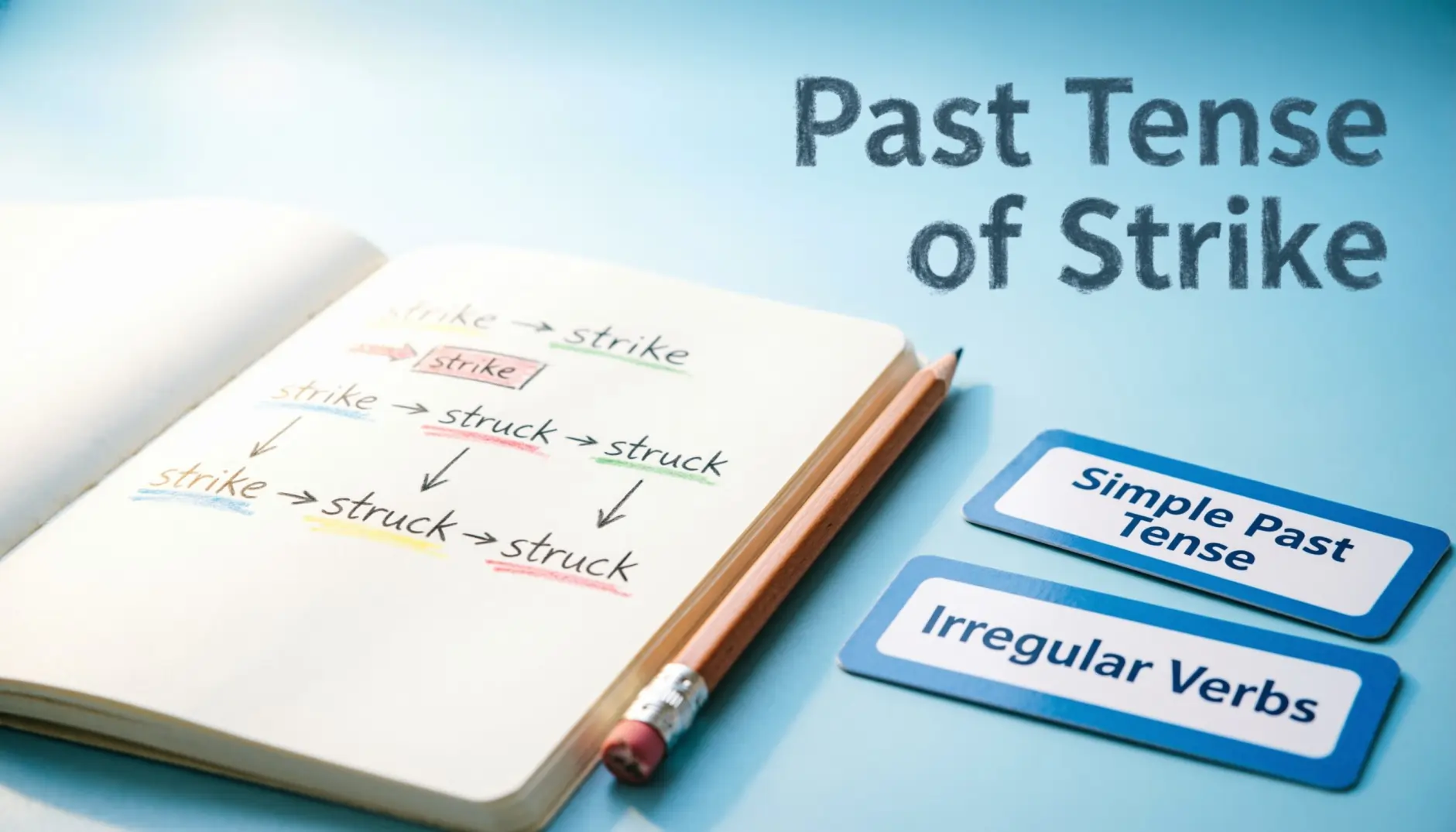
The simple past tense of strike is struck. The past participle is usually struck, although stricken is also used in certain formal expressions and as an adjective. Never use striked in standard English.
| Base Verb (V1) | Past Tense (V2) | Past Participle (V3) |
|---|---|---|
| strike | struck | struck / strick |
Example:
- Present: I strike the ball.
- Past: I struck the ball.
- Past Participle: The city was struck by a storm.
Is It “Striked” or “Struck”?
Many English learners wonder whether the correct past tense of strike is striked or struck.
The correct form is struck.
Because strike is an irregular verb, it does not follow the regular -ed pattern used by most English verbs.
✔ I struck the ball.
✔ Lightning struck the tree.
❌ I striked the ball.
Remember that striked is not accepted in standard English.
What Is Past Tense of Strike?
The past tense of strike is struck. We use it to describe an action or event that happened and finished in the past. Since strike is an irregular verb, it does not follow the regular -ed pattern. Instead of saying striked, the correct form is struck.
Meaning of Strike
The verb strike can have several meanings:
- To hit something
- To suddenly occur
- To affect someone
- To stop working as a protest
- To discover or think of something
Examples
- The boxer struck his opponent.
- An idea struck me yesterday.
- Lightning struck the tree.
- Workers struck for better pay.
In all these examples, struck is the correct past tense form.
When Do We Use the Verb “Strike”?
The verb strike has several meanings, and the correct interpretation depends on the context. It can describe:
- hitting someone or something
- being affected by a natural disaster
- suddenly thinking of an idea
- workers refusing to work as a protest
- making an agreement or deal
Although the meaning changes, the simple past tense remains struck in every case.
Structure of Sentences of Past Tense of Strike
Affirmative Sentences
Subject + struck + object
Examples:
- I struck the ball.
- She struck the match.
- They struck a deal.
Negative Sentences
Subject + did not + strike + object
Examples:
- I did not strike the ball.
- She did not strike the match.
- They didn’t strike a deal.
Interrogative Sentences
Did + subject + strike + object?
Examples:
- Did you strike the ball?
- Did she strike the match?
- Did they strike a deal?
Remember that after did, we use the base form strike, not struck.
Formation of Past Tense of Strike
Since strike is an irregular verb, its forms do not follow the regular -ed pattern.
The three main forms are:
Strike → Struck → Struck
- V1 (Base Form): strike
- V2 (Past Tense): struck
- V3 (Past Participle): struck
- Alternative/formal participle: stricken
- Present Participle: striking
Examples:
- Present: They strike the target.
- Past: They struck the target.
- Present Perfect: They have struck the target.
- Passive: The city was struck by a storm.
Important: Struck is the normal past tense and the most common past participle. Stricken is mainly used in certain formal expressions and as an adjective, such as poverty-stricken, grief-stricken, or disaster-stricken.
So, when you are asked for the basic three forms of strike, remember:
strike – struck – struck
How to Use Past Tense of Strike
The past tense struck can be used in several situations.
When Someone Hits Something
- He struck the ball with great force.
- The boxer struck his opponent.
While Lightning Hits
- Lightning struck the building.
- The storm struck the coast last night.
When an Idea Suddenly Comes
- An interesting thought struck me.
- It suddenly struck her that she was late.
When a Disaster Affects a Place
- An earthquake struck the city.
- Disease struck the village.
While Workers Protest
- Factory workers struck for higher wages.
- Employees struck for better working conditions.
When an Agreement Is Made
- The companies struck a deal.
- The teams struck an agreement quickly.
Past Tense of Strike in Different Contexts
The verb strike is used in many situations, but its past tense remains struck regardless of the meaning.
| Context | Example |
|---|---|
| Hit something | He struck the ball. |
| Lightning | Lightning struck the tree. |
| Workers’ protest | The workers struck for higher wages. |
| Agreement | The companies struck a deal. |
| Sudden realization | An idea struck me yesterday. |
Structure / Verb Pattern Table (Strike → Struck)
| Usage | Structure | Example |
|---|---|---|
| Affirmative | Subject + struck + object | She struck the bell. |
| Negative | Subject + did not + strike + object | She did not strike the bell. |
| Question | Did + subject + strike + object? | Did she strike the bell? |
| Present Perfect | Subject + has/have + struck | She has struck the bell. |
| Past Perfect | Subject + had + struck | She had struck the bell. |
Real Life Examples
Everyday Actions
- He struck the ball into the net.
- She struck the door with her hand.
- The child accidentally struck the table.
Natural Events
- Lightning struck the tree.
- A hurricane struck the coast.
- A powerful earthquake struck the region.
Ideas and Realizations
- A great idea struck me during class.
- It struck him that he had forgotten his keys.
- The answer suddenly struck her.
Business and Agreements
- The two companies struck a partnership.
- They struck a deal after weeks of discussion.
Negative Examples
- I did not strike anyone.
- The storm did not strike our town.
Questions
- Did lightning strike nearby?
- Did the workers strike yesterday?
Common Mistakes
Mistake 1: Using “Striked”
❌ He striked the ball.
✅ He struck the ball.
Explanation: Strike is irregular. The correct past tense is struck.
Mistake 2: Using Struck After Did
❌ Did you struck the ball?
✅ Did you strike the ball?
Explanation: After did, use the base verb.
Mistake 3: Using stricken as Simple Past
❌ Lightning stricken the house.
✅ Lightning struck the house.
Explanation: Use struck for the simple past tense.
Mistake 4: Double Past Forms
❌ He did not struck the bell.
✅ He did not strike the bell.
Explanation: The auxiliary did already shows the past.
Is “Stricken” the Same as “Struck”?
Not exactly.
Although both come from the verb strike, they are used differently.
- Struck is the normal past tense and the most common past participle.
- Stricken is mainly used as an adjective or in formal expressions.
Examples:
- The storm struck the village.
- The village was stricken by floods.
- A poverty-stricken community.
Key Grammar Rules
1: Strike Is an Irregular Verb
- Strike → Struck
- Not: Strike → Striked
2: Use Struck for Simple Past
- She struck the ball.
- The storm struck the city.
3: Use Base Verb After Did
- Did you strike it?
- I did not strike it.
4: Struck Is Commonly Used as Past Participle
- The storm has struck again.
- Disease has struck the region.
5: stricken Is Mostly Used in Formal Contexts
- A drought stricken area
- A grief stricken family
6: Context Determines Meaning
The same verb can mean:
- Hit
- Affect
- Occur suddenly
- Protest
- Reach an agreement
Comparisons with Similar Grammar Forms
Strike vs Struck
| Form | Usage | Example |
| Strike | Present tense | I strike the ball. |
| Struck | Past tense | I struck the ball. |
Struck vs stricken
| Form | Usage | Example |
| Struck | Past tense and common participle | The storm struck the city. |
| stricken | Formal participle/adjective | People with low-income community |
Strike vs Hit
Both can mean “to hit.”
Strike
- Often more formal
- Used in many figurative meanings
Example:
- Lightning struck the tower.
Hit
- More common in everyday speech
Example:
- He hit the ball.
Strike vs Attack
Strike can describe a sudden hit or impact.
Attack usually describes an intentional act against someone.
Examples:
- Lightning struck the building.
- The army attacked the city.
Learners may also want to study other irregular verbs such as drive–drove–driven, write–wrote–written, speak–spoke–spoken, and break–broke–broken.
Exercises
1: Fill in the Blanks
Use the correct form of strike.
- Lightning ______ the tree last night.
- An idea ______ me during the meeting.
- The workers ______ for higher wages.
- She ______ the ball hard.
- The storm ______ the coast yesterday.
2: Correct the Mistakes
- He striked the door.
- Did she struck the bell?
- They did not struck a deal.
- The storm stricken the town.
- We striked the target.
3: Rewrite in the Past Tense
- I strike the ball.
- They strike for better pay.
- Lightning strikes the tower.
- She strikes a match.
- We strike an agreement.
4: Multiple Choice
What is the past tense of strike?
A. Striked
B. Struck
C. Striking
D. stricken
Which sentence is correct?
A. He striked the ball.
B. He has strike the ball.
C. He struck the ball.
D. He striking the ball.
Which sentence uses the verb correctly?
A. Did you struck it?
B. Did you strike it?
C. Did you stricken it?
D. Did you striking it?
Which word is commonly used as the past participle?
A. Strike
B. Striking
C. Struck
D. Strikes
Answer Key
1
- struck
- struck
- struck
- struck
- struck
2
- He struck the door.
- Did she strike the bell?
- They did not strike a deal.
- The storm struck the town.
- We struck the target.
3
- I struck the ball.
- They struck for better pay.
- Lightning struck the tower.
- She struck a match.
- We struck an agreement.
4
- B
- C
- B
- C
FAQs
What is the past tense of strike?
The past tense of strike is struck.
What is the past participle of strike?
The past participle is usually struck, although stricken appears in some formal expressions.
Can I say “an idea struck me”?
Yes. This is a very common and natural expression.
What is the difference between struck and stricken ?
Struck is the normal past tense and common participle. stricken is often used as an adjective or in formal writing.
Is strike a regular or irregular verb?
It is an irregular verb because its past tense changes to struck instead of adding ed.
What is the past tense of lightning strike?
When talking about lightning, the past tense is struck.
Example:
Lightning struck the tallest tree in the park.
What is the past tense of “strike a deal”?
The correct past tense is struck a deal.
Example:
The two companies struck a deal after several meetings.
What is the past tense of strike when workers protest?
When strike means refusing to work as a protest, the past tense is still struck.
Example:
The factory workers struck for better pay.
What is the second form (V2) of strike?
The second form (V2) of strike is struck. It is used when talking about actions that happened in the past.
Example:
✔ She struck the ball.
What are the three forms of the verb strike?
The three main forms of the verb strike are:
- V1: Strike
- V2: Struck
- V3: Struck (or stricken in some formal contexts)
Since strike is an irregular verb, these forms do not follow the regular -ed pattern.
Conclusion
The past tense of strike is struck, and it is the correct form to use when describing actions or events that happened in the past.
While stricken still appears in formal English and adjective phrases such as disaster-stricken or poverty-stricken, it is not normally used as the simple past tense. Avoid incorrect forms like striked, and remember to use the base verb strike after did.
With regular practice and real-life examples, you’ll become confident using strike, struck, and stricken correctly in everyday English.