Have you ever read a sentence like “She visited her grandmother last weekend” and wondered why the verb changes? Or maybe you’re learning Spanish and keep hearing about the preterite tense but aren’t quite sure what it means.
Many learners confuse the preterite tense with other past tenses because several grammar terms seem similar. Some people think the preterite tense is different from the simple past tense, while others aren’t sure when it should be used.
Understanding the preterite tense is important because it helps you talk about actions that happened and finished in the past.
If you’re writing a story, describing yesterday’s activities, learning English grammar, or studying Spanish, knowing how the preterite tense works can make communication much clearer.
In this guide, you’ll learn what the preterite tense is, how it is formed, when to use it, common mistakes to avoid, and plenty of real life examples to help you master it.
Quick Answer (Featured Snippet)
The preterite tense is a verb tense used to describe actions that happened and were completed in the past. In English, it is generally the same as the simple past tense.
| Example | Meaning |
| I walked home. | The action happened and finished in the past. |
| She called me yesterday. | The call was completed in the past. |
What Is the Preterite Tense?
The preterite tense is a grammatical term used for actions that occurred and ended in the past.
In English grammar, the preterite tense is usually called the simple past tense. It shows that an action started and finished before the present moment.
Examples
- I visited my friend yesterday.
- She watched a movie last night.
- They played football after school.
- We traveled to Lahore last month.
In each sentence, the action is complete and belongs entirely to the past.
Function of the Preterite Tense
The preterite tense is used to:
- Describe completed past actions
- Tell stories and narrate events
- Report past experiences
- Explain what happened at a specific time
More Examples
- He finished his homework.
- The train arrived on time.
- We enjoyed the concert.
- I bought a new notebook.
These actions happened once and are now finished.
Structure of Sentences of Preterite Tense
The preterite tense follows simple sentence patterns.
Affirmative Structure
Subject + V2 (Past Form) + Object
Examples:
- I visited the museum.
- She cleaned her room.
- They played cricket.
Negative Structure
Subject + did not (didn’t) + V1 + Object
Examples:
- I did not visit the museum.
- She didn’t clean her room.
- They didn’t play cricket.
Interrogative Structure
Did + Subject + V1 + Object?
Examples:
- Did you visit the museum?
- Did she clean her room?
- Did they play cricket?
Interrogative Negative Structure
Didn’t + Subject + V1 + Object?
Examples:
- Didn’t you call me?
- Didn’t she finish the project?
Formation of Preterite Tense
The preterite tense is formed by using the past form (V2) of the main verb.
Regular Verbs
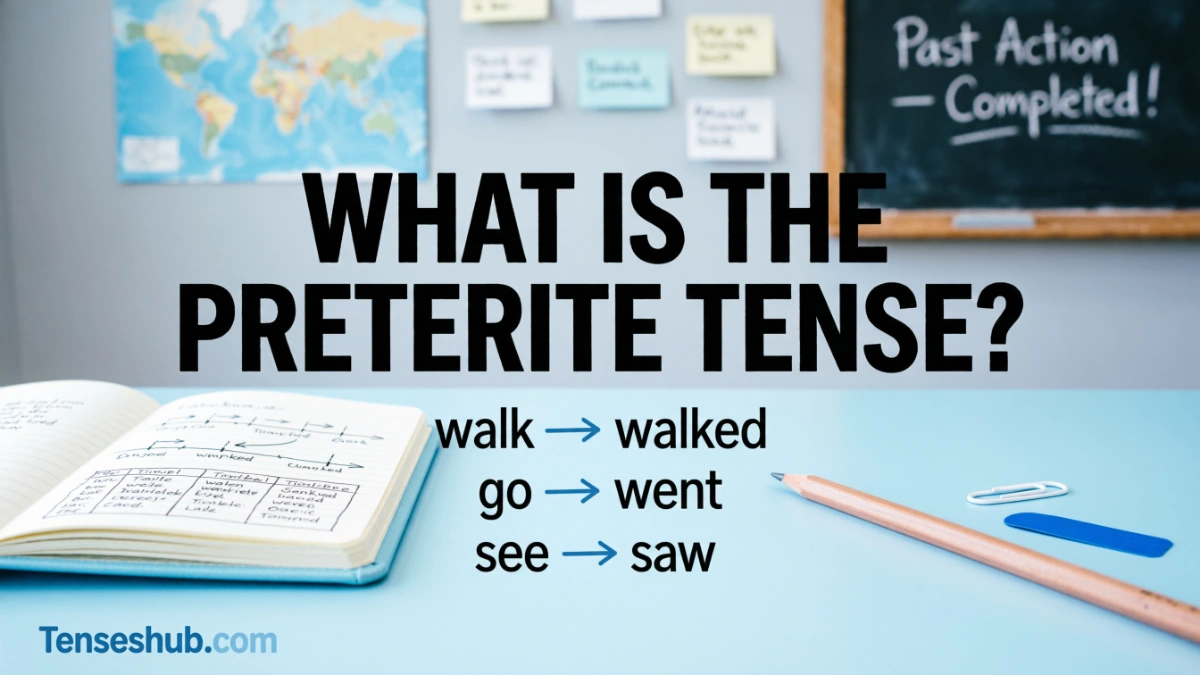
Most regular verbs add ed to the base form.
| Base Verb | Preterite Form |
| Walk | Walked |
| Play | Played |
| Clean | Cleaned |
| Visit | Visited |
Irregular Verbs
Some verbs change completely.
| Base Verb | Preterite Form |
| Go | Went |
| See | Saw |
| Eat | Ate |
| Buy | Bought |
| Write | Wrote |
Common Spelling Rules
Add d
If the verb ends in e, add d.
- Live → Lived
- Love → Loved
Change y to i and Add ed
- Carry → Carried
- Study → Studied
Double the Final Consonant
- Stop → Stopped
- Plan → Planned
Contractions
Negative forms are often shortened.
- Did not → Didn’t
- She did not go. → She didn’t go.
How to Use Preterite Tense
The preterite tense has several practical uses.
1. Completed Actions in the Past
Use it when an action is finished.
Examples:
- I finished my work.
- She opened the door.
2. Actions at a Specific Time
Examples:
- We met on Monday.
- He arrived at 8 p.m.
3. A Series of Past Events
Examples:
- I woke up, ate breakfast, and left for work.
- She packed her bag and caught the bus.
4. Historical Facts
Examples:
- The company started in 1995.
- The war ended in 1945.
5. Storytelling
Examples:
- The boy entered the room and found a treasure map.
- She opened the letter and smiled.
Time Expressions Commonly Used
- Yesterday
- Last week
- Last year
- Two days ago
- In 2020
- This morning (when finished)
Examples:
- I called him yesterday.
- They moved here last year.
Structure or Verb Pattern Table
| Sentence Type | Formula | Example |
| Affirmative | Subject + V2 + Object | She visited Paris. |
| Negative | Subject + did not + V1 + Object | She did not visit Paris. |
| Interrogative | Did + Subject + V1 + Object? | Did she visit Paris? |
| Negative Question | Didn’t + Subject + V1 + Object? | Didn’t she visit Paris? |
Real Life Examples
Daily Life
- I cooked dinner yesterday.
- She washed the dishes.
- We watched television.
School
- The teacher explained the lesson.
- I completed my assignment.
- They passed the exam.
Workplace
- He submitted the report.
- The manager approved the request.
- We finished the project.
Travel
- They visited Islamabad.
- I stayed in a hotel.
- We explored the city.
Informal Conversation
- I saw your message.
- We had a great time.
- She called me later.
Formal Writing
- The committee approved the proposal.
- The company launched a new product.
- The meeting concluded successfully.
Common Mistakes
| Wrong | Correct | Explanation |
| I did went there. | I did go there. | Use V1 after did. |
| She didn’t visited me. | She didn’t visit me. | Use base verb after didn’t. |
| Did he saw the movie? | Did he see the movie? | Use V1 after did. |
| We goed home. | We went home. | Go is irregular. |
| He buyed a car. | He bought a car. | Buy is irregular. |
Common Learner Problem
Many learners incorrectly use both did and a past verb together.
❌ Did you finished?
✅ Did you finish?
Only one past marker is needed.
Key Grammar Rules
1. Use the Preterite Tense for Completed Past Actions
- I finished the book.
2. Use the Past Form (V2) in Affirmative Sentences
- She called me.
3. Use the Base Form (V1) After Did
- Did you call me?
4. Use the Base Form After Didn’t
- I didn’t call him.
5. Learn Common Irregular Verbs
- Go → Went
- See → Saw
- Take → Took
6. Time Expressions Often Indicate the Preterite
- Yesterday
- Last night
- Last month
7. Completed Actions Are More Important Than Duration
- He wrote the email.
The action is complete.
Comparisons with Similar Grammar Forms
Preterite Tense vs Present Perfect
Preterite
- I visited London in 2022.
Present Perfect
- I have visited London.
Difference:
The preterite mentions a specific completed time. The present perfect focuses on experience.
Preterite Tense vs Past Continuous
Preterite
- I read a book.
Past Continuous
- I was reading a book.
Difference:
The preterite shows a completed action. The past continuous shows an action in progress.
Preterite Tense vs Simple Present
Preterite
- She worked yesterday.
Simple Present
- She works every day.
Difference:
One refers to the past; the other refers to the present or habitual actions.
Exercises
1: Fill in the Blanks
Use the correct preterite form.
- I _____ (visit) my uncle yesterday.
- She _____ (buy) a new phone.
- We _____ (play) football.
- He _____ (go) to school.
- They _____ (watch) a movie.
2: Correct the Mistakes
- She didn’t watched TV.
- Did you ate lunch?
- We goed home.
- He did finished the task.
- They didn’t saw me.
3: Rewrite as Negative
- I visited Paris.
- She called me.
- They played cricket.
4: Rewrite as Questions
- He finished the work.
- She opened the window.
- They bought a car.
5: Multiple Choice
1. Which sentence is correct?
A. She did went home.
B. She went home.
C. She gone home.
2. Which verb is the preterite form of “see”?
A. Seen
B. Seeing
C. Saw
3. Which sentence is correct?
A. Did you watched it?
B. Did you watch it?
C. Did you watching it?
Answer Key
1
- visited
- bought
- played
- went
- watched
2
- She didn’t watch TV.
- Did you eat lunch?
- We went home.
- He finished the task.
- They didn’t see me.
3
- I didn’t visit Paris.
- She didn’t call me.
- They didn’t play cricket.
4
- Did he finish the work?
- Did she open the window?
- Did they buy a car?
5
- B
- C
- B
FAQs
Is the preterite tense the same as the simple past tense?
In English grammar, yes. The term preterite tense usually refers to the simple past tense.
When should I use the preterite tense?
Use it for actions that happened and finished in the past.
What is an example of a preterite sentence?
- I watched a movie yesterday.
Can irregular verbs be used in the preterite tense?
Yes.
Examples:
- Go → Went
- Eat → Ate
- Buy → Bought
Why do we use the base verb after “did”?
Because “did” already shows past time.
Correct:
- Did you go?
Incorrect:
- Did you went?
What words often signal the preterite tense?
Common signal words include:
- Yesterday
- Last week
- Last year
- Ago
- In 2019
Is the preterite tense used in storytelling?
Yes. Most stories use the preterite tense to describe completed events.
Conclusion
The preterite tense is one of the most important grammar forms for talking about the past. In English, it is essentially the same as the simple past tense and is used for actions that happened and finished before the present moment.
Learning how to form regular and irregular verbs, use correct sentence structures, and avoid common mistakes will greatly improve your speaking and writing skills.
Remember that affirmative sentences use the past form of the verb, while negative and question forms use did with the base verb. The more examples you read and practice, the more natural the preterite tense will become.
Keep using it in daily conversations, writing exercises, and storytelling, and you’ll build confidence in expressing past events accurately and clearly.

Hi, I’m Noah Bester, a tenses expert passionate about simplifying English grammar. I create practical, easy-to-understand guides to help learners master tenses with confidence. My goal is to make grammar clear, useful, and applicable in everyday communication. tenseshub.com