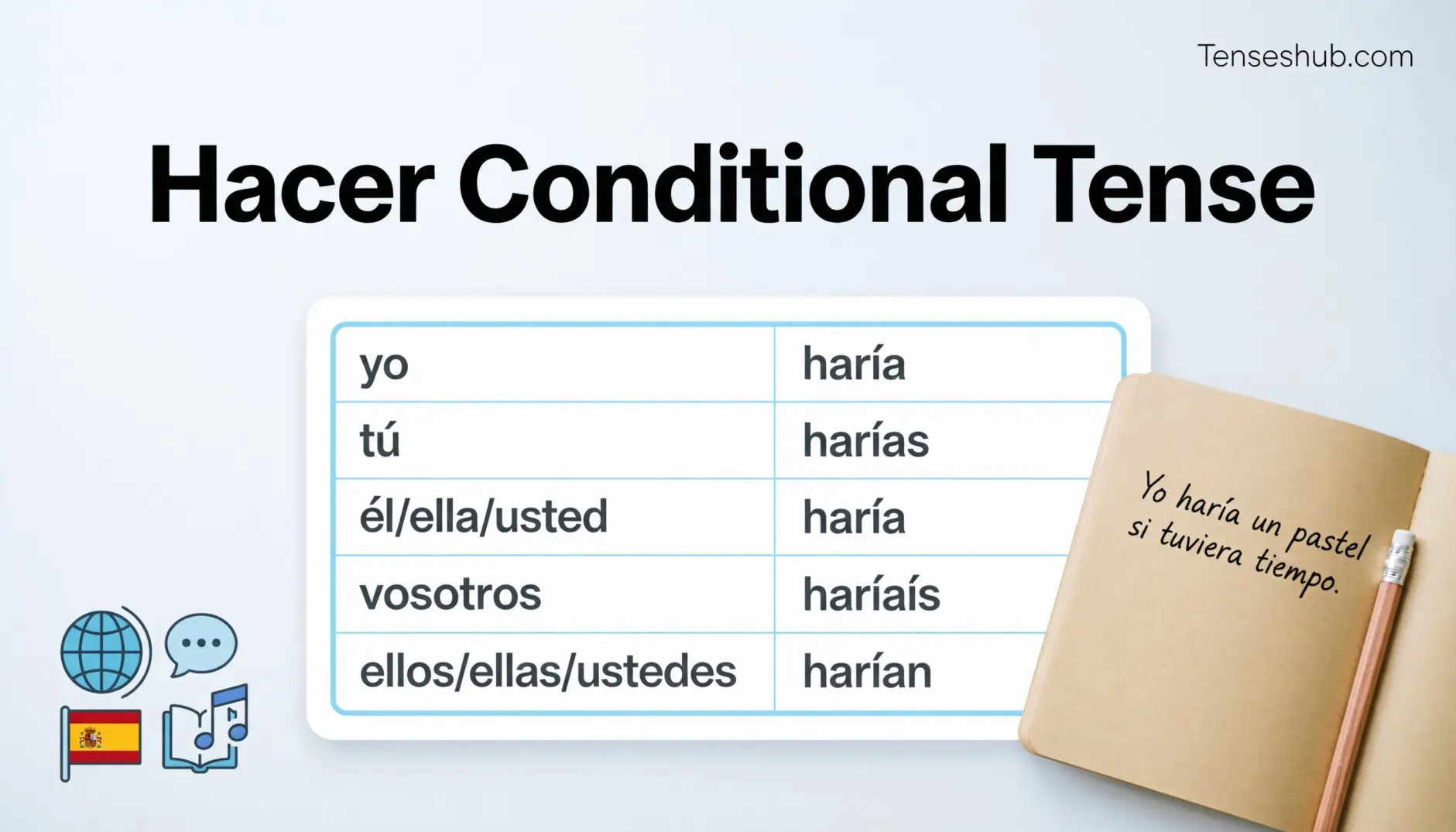
Many Spanish learners understand present and past tenses but become confused when they want to say things like “I would do it,” “we would make dinner,” or “what would you do?” This is where the hacer conditional tense becomes important.
The verb hacer is one of the most common Spanish verbs. It usually means to do or to make, and it appears in countless everyday conversations. Learning its conditional form helps you express possibilities, polite requests, hypothetical situations, wishes, and future actions viewed from the past.
Because hacer is an irregular verb, many learners are unsure how to conjugate it correctly. The good news is that once you understand the pattern, using the conditional tense becomes much easier.
In this guide, you will learn the meaning, formation, sentence structure, uses, examples, common mistakes, grammar rules, comparisons, exercises, and FAQs related to the hacer conditional tense.
Quick Answer (Featured Snippet)
Hacer Conditional Conjugation
| Subject | Conditional Form |
|---|---|
| Yo | haría |
| Tú | harías |
| Él / Ella | haría |
| Nosotros | haríamos |
| Vosotros | haríais |
| Ellos | harían |
What Is Hacer Conditional Tense?
The hacer conditional tense is the conditional form of the Spanish verb hacer (to do, to make).
It is used to talk about:
- Hypothetical situations
- Possibilities
- Polite requests
- Advice
- Future actions from a past perspective
Examples
- Yo haría eso.
(I would do that.) - Ella haría una torta.
(She would make a cake.) - ¿Qué harías tú?
(What would you do?)
In English, the conditional tense is usually translated using would + verb.
Structure of Sentences of Hacer Conditional Tense
Affirmative Structure
Subject + hacer (conditional form) + complement
Examples:
- Yo haría mi tarea.
- Nosotros haríamos la cena.
- Ellos harían el trabajo.
Negative Structure
Subject + no + hacer (conditional form) + complement
Examples:
- Yo no haría eso.
- Ella no haría una fiesta.
- Nosotros no haríamos cambios.
Interrogative Structure
¿Conditional form of hacer + complement?
Examples:
- ¿Harías eso por mí?
- ¿Harían ustedes el proyecto?
- ¿Qué haría ella?
Formation of Hacer Conditional Tense
The verb hacer is irregular in the conditional tense.
Instead of using the infinitive hacer, it changes its stem to har before adding conditional endings.
Formula
har + conditional endings
Conditional Endings (Spanish Verbs)
| Subject | Ending | Form (Hacer) |
|---|---|---|
| Yo | -ía | haría |
| Tú | -ías | harías |
| Él / Ella / Usted | -ía | haría |
| Nosotros / Nosotras | -íamos | haríamos |
| Vosotros / Vosotras | -íais | haríais |
| Ellos / Ellas / Ustedes | -ían | harían |
Examples
- Yo haría
- Tú harías
- Él haría
- Nosotros haríamos
- Vosotros haríais
- Ellos harían
Unlike many other verb forms, the endings remain the same for all verb types ( ar, er, and ir verbs) in the conditional tense.
How to Use Hacer Conditional Tense
1. To Express Hypothetical Actions
Use the conditional tense when talking about situations that are imagined or uncertain.
Examples:
- Yo haría más ejercicio si tuviera tiempo.
- Ella haría el viaje si tuviera dinero.
2. To Give Advice
The conditional tense often softens suggestions.
Examples:
- Yo haría una lista primero.
- Tú harías bien en estudiar más.
3. For Polite Requests
Conditional forms sound more polite than direct statements.
Examples:
- ¿Harías un favor por mí?
- ¿Haría usted una llamada?
4. To Express Future from a Past Perspective
The conditional tense can describe something that was expected to happen later.
Examples:
- Pensé que él lo haría mañana.
- Sabíamos que ellos harían cambios.
5. To Discuss Possibilities
Examples:
- Quizás haría eso.
- Ella haría cualquier cosa para ayudar.
Structure / Verb Pattern Table (Conditional: Hacer)
| Sentence Type | Formula | Example |
|---|---|---|
| Affirmative | Subject + haría/harías/etc. + complement | Yo haría eso. |
| Negative | Subject + no + haría/harías/etc. + complement | Yo no haría eso. |
| Question | ¿Haría/Harías/etc. + complement? | ¿Harías eso? |
| Polite Request | ¿Harías…? | ¿Harías un favor? |
| Hypothetical Situation | Haría + if clause context | Haría eso si pudiera. |
Real Life Examples
Here are practical examples you may hear in daily conversations.
Affirmative Examples
- Yo haría la comida esta noche.
- Ella haría un excelente trabajo.
- Nosotros haríamos cualquier cosa para ayudar.
- Ellos harían una fiesta grande.
Negative Examples
- Yo no haría eso otra vez.
- Ella no haría daño a nadie.
- Nosotros no haríamos esa elección.
- Ellos no harían trampa.
Questions
- ¿Harías eso por tu amigo?
- ¿Qué haría él en esta situación?
- ¿Harían ustedes el trabajo?
- ¿Haríamos una reserva?
Formal Examples
- ¿Haría usted el informe mañana?
- La empresa haría cambios importantes.
Informal Examples
- ¿Harías mi tarea?
- Yo haría lo mismo.
Common Mistakes
Mistake 1: Using the Wrong Stem
❌ Hacería eso.
✅ Haría eso.
Explanation: The stem changes from hacer to har .
Mistake 2: Using Future Instead of Conditional
❌ Haré eso si tuviera tiempo.
✅ Haría eso si tuviera tiempo.
Explanation: Hypothetical situations usually require the conditional tense.
Mistake 3: Forgetting the Accent Mark
❌ Haria una torta.
✅ Haría una torta.
Explanation: Conditional endings require written accents.
Mistake 4: Direct English Translation Errors
❌ Yo haría puedo hacerlo.
✅ Yo podría hacerlo.
Explanation: Not every English “would” expression uses hacer.
Key Grammar Rules
Rule 1
Hacer becomes har in the conditional tense.
Example:
- Yo haría eso.
Rule 2
All conditional endings contain an accent mark.
Example:
- haría
- harías
- haríamos
Rule 3
Conditional tense often means would do or would make.
Example:
- Ella haría una torta.
Rule 4
Conditional tense commonly appears with si (if) clauses.
Example:
- Haría eso si pudiera.
Rule 5
Use it to sound more polite.
Example:
- ¿Harías un favor?
Rule 6
Conditional endings are the same for all verb groups.
Example:
- comería
- viviría
- haría
Comparisons with Similar Grammar Forms
Hacer: Conditional vs Future
| Tense | Meaning | Form |
|---|---|---|
| Conditional | Would do | Haría |
| Future | Will do | Haré |
Examples:
- Yo haría eso. (I would do that.)
- Yo haré eso. (I will do that.)
Hacer Conditional vs Imperfect
Examples:
- Yo haría eso. (I would do that.)
- Yo hacía eso. (I used to do that.)
The meanings are completely different.
Hacer Conditional vs Present Tense
Examples:
- Yo hago eso. (I do that.)
- Yo haría eso. (I would do that.)
The present tense describes reality, while the conditional describes possibility or hypotheticals.
Exercises
Exercise 1: Fill in the Blanks
Complete the sentences with the correct form of hacer.
- Yo _______ eso.
- Tú _______ una pizza.
- Nosotros _______ el trabajo.
- Ella _______ un pastel.
- Ellos _______ cambios.
Exercise 2: Correct the Mistakes
- Yo hacería eso.
- Ella haria una torta.
- Nosotros haremos eso si pudiéramos.
- Tú no haria eso.
- Ellos hacerían el trabajo.
Exercise 3: Rewrite the Sentences
Change the sentences to the conditional tense.
- Yo hago la cena.
- Ella hace una torta.
- Nosotros hacemos el trabajo.
- Tú haces eso.
- Ellos hacen cambios.
Exercise 4: Multiple Choice
1. Which form means “I would do”?
A) hago
B) haré
C) haría
D) hacía
2. Which stem is used in the conditional tense of hacer?
A) hac
B) har
C) hiz
D) haci
3. Which sentence is correct?
A) Yo hacería eso.
B) Yo haria eso.
C) Yo haría eso.
D) Yo hare eso.
Answer Key
Exercise 1
- haría
- harías
- haríamos
- haría
- harían
Exercise 2
- Yo haría eso.
- Ella haría una torta.
- Nosotros haríamos eso si pudiéramos.
- Tú no harías eso.
- Ellos harían el trabajo.
Exercise 3
- Yo haría la cena.
- Ella haría una torta.
- Nosotros haríamos el trabajo.
- Tú harías eso.
- Ellos harían cambios.
Exercise 4
- C
- B
- C
FAQs
What does haría mean?
Haría means would do or would make depending on the context.
Is hacer irregular in the conditional tense?
Yes. The stem changes from hacer to har .
What is the conditional form of hacer for nosotros?
Haríamos.
How do you say “What would you do?” in Spanish?
¿Qué harías?
Is haría the same as haré?
No.
- Haría = would do
- Haré = will do
When should I use hacer conditional tense?
Use it for hypothetical situations, polite requests, possibilities, advice, and future actions viewed from the past.
Conclusion
The hacer conditional tense is an essential Spanish grammar topic because it helps you express ideas such as would do, would make, possibilities, polite requests, and hypothetical situations.
Although hacer is an irregular verb, its conditional form is easy to remember once you learn the stem change from hacer to har and add the correct conditional endings.
Remember that forms like haría, harías, and haríamos are commonly used in everyday Spanish conversations. They help speakers sound more natural, polite, and accurate when discussing imagined situations or giving advice.
Practice creating your own sentences with hacer conditional tense, especially with si clauses and real life situations. The more you use these forms, the more confident and fluent your Spanish will become.